Speaker & Worship Leader:- Maria Hayward
The service opens with a whakatauki (proverb) and introduction to the theme. The readings are a personal story and an outsider’s perspective of Te Ao Māori in Aotearoa, reminding us of our unique and special home. The talk will cover the basics of pronunciation and key words that may have meaning for members. 3 waiata will be sung. The discussion will comprise a mini te reo lesson in small groups.
Video to come
Audio to come
Read below, or download the PDF
Maria Hayward © 14 September 2025
I’d like to begin with a whakatauki. This proverb, which talks of searching, listening, working and striving together, with love and compassion, so that we can reach our goal – seems to fit with the shared effort that is required to sustain and grow Te Reo in Aotearoa.
Ma te titiro, ma te whakarongo, ma te mahitahi, ma te manawanui, ma te aroha. Ka taea e au.
The theme for Māori language week this year is: Ake ake ake – keep going, sustain the language. Last week while I was researching for today’s korero, I found a photo online that triggered a strong emotion in me because of a personal connection. I share this with you as a way of illustrating how easily we, as pakeha can dismiss or not concern ourselves about the effects of colonisation and institutional racism. We know it’s wrong – but we don’t always feel it. It has never affected us. But sometimes it does. An event or a situation does come close to home.
What happened to me is this: I had recalled that close family members had attended a Māori primary school – these were rather curiously called “native schools”. Many years ago, whilst on a family memory tour, we visited the cute old country school building in Papamoa, near Tauranga. I was wondering why these segregated schools existed – they weren’t ‘kura’ because no Reo Māori was spoken or learnt.
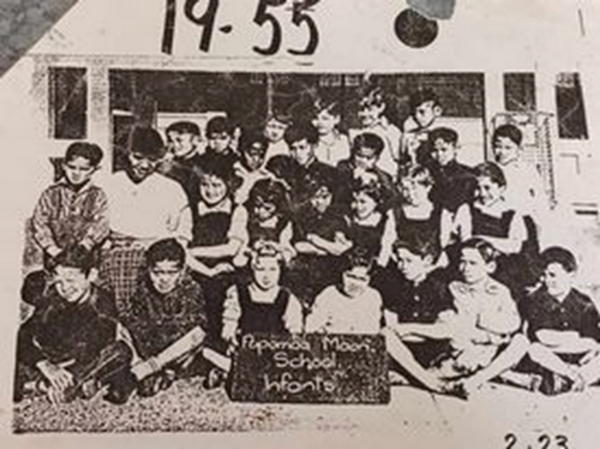
Te Ara Encyclopaedia of New Zealand, informed me: there were hundreds of ‘native’ schools around the country which were designed: “primarily to assimilate Māori people into Pākehā (European) society, to teach them English, and displace communal land ownership in favour of individual property. Driven by colonial ambitions and a belief in European cultural superiority, these state-funded schools were seen as a tool to “civilise” Māori and prepare them for a subordinate role as a labouring underclass”. And continuing from the same source: “A central goal was to replace their language, customs, and values with those of the British. Instruction in these schools was mandated to be in English”.
I felt somehow very sad and shocked and mildly traumatised to read this was the kaupapa – the philosophy – of the school this family member attended as a child. A few days later a colleague told me that someone she knew who went to a ‘native’ school, was taught things like ‘how to iron’ and other domestic tasks not taught (to my knowledge) in mainstream primary schools. Luckily that covert government plan didn’t work on the family I’m related to – but it did succeed on many thousands of other children who failed in a system that explicitly sought to teach them they were second class citizens. And it did that for over 100 years.
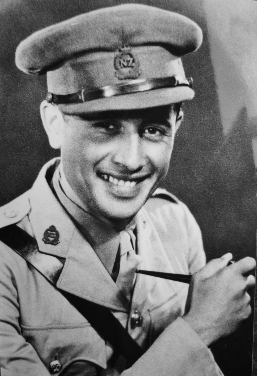
Let’s go back a generation: My children’s grandfather belonged to that generation of Māori in Aotearoa who were punished at school for speaking their home language. With the “Native Schools Act”, 1867, but especially from the beginning of the 20
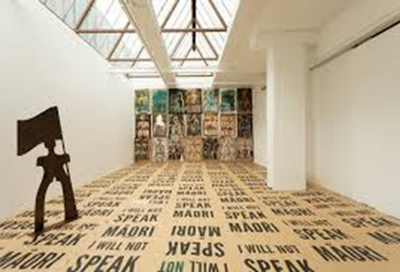
th century right up until the 1970’s, 100’s of 1000’s of Māori children were, at best discouraged, but, more frequently, beaten by teachers and forced to write the phrase: “I will not speak Māori” on the blackboard because they broke the English only rule.
You’ll be familiar with the Tama Iti painting and installation in which he reminds us of his personal experience.
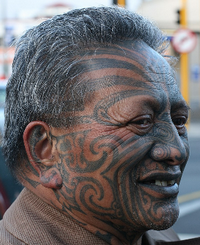
So, Te Reo was lost to two generations of Māori families in this country. However, thanks to a few brave and steadfast individuals, finally, in 1987, the Māori Language Act, established Māori as an official language of Aotearoa, and Te Reo was slowly revitalised. So, the younger mokopuna (grandchildren) of Tama Iti and those of his contemporaries were able to receive the gift, the ‘taonga’, of their ancestors.
I recall my younger daughter coming home from school at about age 6 or 7, and she mentioned that her school was setting up a kapahaka group. As a child with Māori heritage, she would be given priority in being allowed to join (she felt hugely privileged) – and such was the ‘mana’, the prestige, of this group – a child could only be a member if they were also ‘good at school’, so my daughter told me. Alongside the renewal of the language, came a shift in thinking.
And with the increased mana for Te Reo, came an increase in self-esteem – not only for tangata whenua (indigenous/first people) – but for all New Zealanders. We became more proud of our unique country. I’ll read later an outsider’s perspective of this phenomenon. Te Reo classes nowadays are full and there are lengthy waitlists. With the change in attitudes, and lots of people embracing Te Reo – came a renewed appreciation for the quintessentially New Zealand culture – it was no longer – just a mini-Britain. We felt we were unique, precisely because of our indigenous culture and language. The introduction of Māori advisors in lots of work environments resulted in tikanga being shared by all. We loved the pōwhiri, the waiata, the blessings. Our lives were – are – so enriched by being able to learn the language of this land and to participate in new cultural practices that have become part of our everyday lives now.
So, today, for those of you who have never had the advantage of formally learning Te Reo – today begins this exciting journey for you. For those of you who have already learnt Te Reo Māori (and I’m sure most or all of you know some, today is for practising and maybe learning one or two new things to add to your kete matauranga (your basket of knowledge) – language that you can practice during the next 12 months!
We will sing in this service, therefore, 3 waiata. The first one I have chosen is one I’m sure most of you will be familiar with – Te Aroha. It’s very simple – and is generally translated as: Te aroha: compassion, Te Whakapono, trust/faith/self-belief and Rangimārie, peace – these 3 things connect all of us (and reflect our values too).
The waiata for today are below, links are to YouTube performances:-
Reading
I am going to read to you today an article by Sébastien Desclée which was published in the NZ Herald·3 April, 2023. A couple of years ago, but a very interesting – and still relevant, letter as you will hear. This is what he said, link below, behind the Herald paywall:-