Instead of preaching about queer folks as people who need support, I’m inverting it to what can queer and trans people teach the rest of us about being fully human? Especially now, when authoritarianism and even AI are trying to flatten us all into simple categories. I’ll be weaving in the story of the Kapaemahu stones in Waikiki – four healing stones connected to mahu (Hawaiian gender-diverse) practitioners that were literally buried under concrete for decades and then uncovered in the 90s.
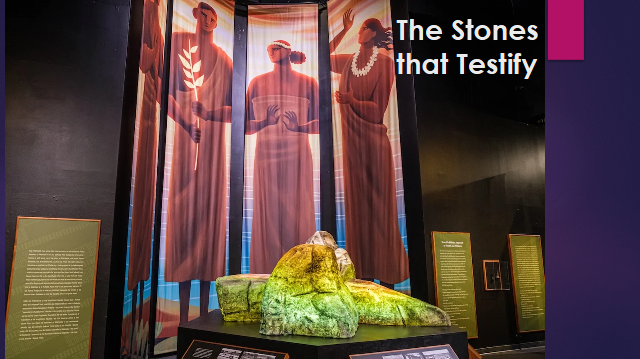
The Stones That TestifyListen, or download the MP3
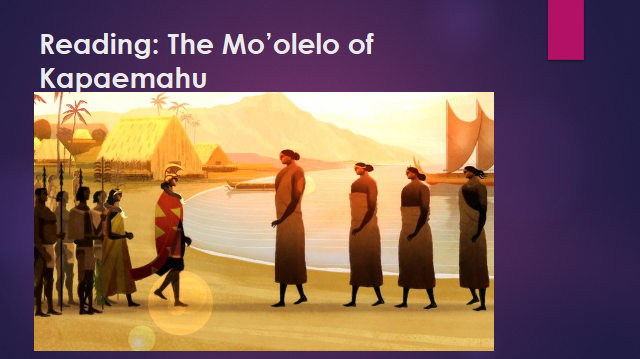
Our reading today comes from Hawaii. It is the ancient legend of the Kapaemahu Stones, which I will talk about in my sermon. Here is the story:
In the 1500s, four Tahitian healers traveled to Hawaii from their home on the island of Raiatea. Their names were Kapaemahu, who was the leader of the group, Kapuni, Kinohi and Kahaloa. They settled in Waikiki.
The healers were mahu – extraordinary individuals of dual male and female mind, heart and spirit. They were beloved by the people for their gentle ways, and their fame spread as they traveled throughout the islands administering their miraculous cures.
When it was time to depart, they asked that two stones be placed at their residence and two at their bathing place in the sea as a permanent reminder of the relief of pain and suffering from their ministrations. Four huge stones were quarried and transported to Waikiki on the night of Kane.
The healers transferred their names and spiritual power to the stones, placing mahu idols under each one. Tradition states that the incantations, fasting and prayers lasted a full cycle of the moon. Then the healers vanished and were seen no more.
I’m standing in a church to preach about LGBT Pride.
For some of you, that sentence doesn’t register as strange. But for queer folks – especially those of us who grew up with religion – there’s a particular feeling that lands in your body when you hear it. Your chest tightens. Your throat closes a bit. Because more often than not, it’s been religious voices telling us we’re broken. Sinful. Less than. Not fully human.
I don’t mean that metaphorically. I mean lawmakers citing scripture to strip our rights. I mean ministers preaching that people like me are confused at best, abominations at worst. I mean people who claim to speak for God declaring that because of how I move through gender, because of who I love, because I refuse to be only one thing – I am somehow less real, less complete, less worthy of dignity.
Some of the loudest voices in my country right now are preaching this gospel of exclusion. And you hear those echoes here too.
And yet here I am. Here we are. In a church. About to do something different.
Because here’s what I want to offer you this Pride season – not as tragedy, not as a call to rescue, but as invitation:
What if queerness isn’t a deficit of humanity but a curriculum in it? What if trans and gender non-conforming folks aren’t asking for your tolerance but offering you teaching about what it means to be fully, complexly, courageously human?
What if we’ve been here all along, standing witness, waiting to be seen?
—
In Hawaii, I grew up hearing the word mahu – but not as an honor. As an insult. A slur. Colonization doesn’t just bury people and places. It buries words. It takes what was sacred and makes it profane.
So I learned safer words to describe myself. Gay. Queer. And those words are true – I still use them. But for years I couldn’t touch mahu. It carried too much poison.
Until I learned what it actually meant before colonization twisted it. In Hawaiian culture, mahu are people who embody both male and female elements – and many were also healers, teachers, keepers of sacred knowledge. When I finally could hold that word as my own, something unlocked. I reclaimed what was stolen.
But here’s the thing – Mahu isn’t about identity in the Western sense. It’s about kuleana – sacred responsibility. To be mahu means you inhabit two worlds at once, and because of that, you have work to do. You translate. You heal the gaps. You carry knowledge between worlds that don’t usually speak.
Western LGBTQ+ language gave me permission to exist. Mahu language gave me a reason to exist – a purpose beyond my own comfort.
—
You just heard the story of those four stones on Waikiki Beach. The mahu healers who left their mana as testimony. The stones that testified: We healed here. We served. We fulfilled our purpose.
But here’s what haunts me about those stones: They were there the whole time. Underneath the concrete, underneath the lies about who deserves dignity, underneath decades of shame – the stones were there. The truth was there. The healing power was there.
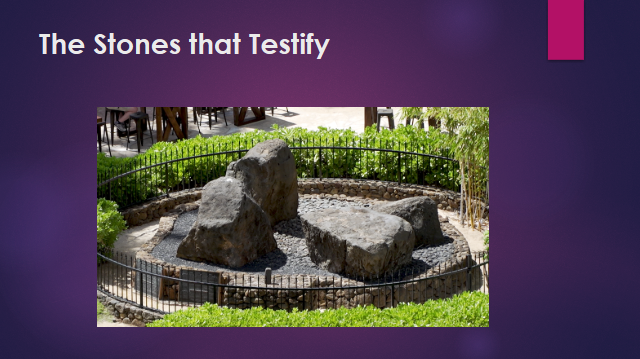
And then – the part of the story I didn’t tell you yet – these stones were buried. Literally covered with concrete under a bowling alley and trash. Hidden for decades because colonizers either didn’t understand their importance or couldn’t handle what they represented.
The Stones today
You can bury something holy. But you cannot destroy it.
—
This is what I want us to sit with today. This is the question I want to put in your body, not just your mind:
What has been buried that needs to be uncovered?
Because queer folks – we’ve been practicing the art of excavation our whole lives. We know what it means to dig through concrete. And we’ve learned some things in that digging.
Some things the world desperately needs right now.
First, we know how to become without permission.
Nobody handed us a roadmap for being ourselves. We had to excavate our own truth from beneath layers of “that’s not normal,” “that’s not biblical,” “that’s not how things are done.”
And that’s not a deficit. That’s a gift. The capacity to trust your own truth when every external voice says otherwise – that’s power. That’s freedom. That’s the skill we all need when the world demands we be simple.
Second, we know how to see ourselves when mirrors lie.
When the culture reflects back a distorted image, when the categories don’t fit, when the language doesn’t even exist yet for what you are – you learn to trust what you feel in your bones more than what you’re told you should be.
You learn that your own knowing is valid. That you don’t need permission to be real.
Third, we know how to make family from love.
When biology fails you, when your given family can’t see you, when the people who were supposed to love you can’t – you learn to build family from chosen bonds.
And sometimes – often – that chosen family teaches you what unconditional love actually means. What it means to be seen completely and loved completely. What it means to be held not despite your complexity but because of it.
Fourth, we know how to hold steady in transition.
To trust that becoming is holy work, not failure. That the in-between spaces – the places where you’re not one thing or the other, where you’re both and neither – those aren’t proof you’re broken.
They’re proof you’re brave enough to grow.
Finally, we know, in our bones, that being whole doesn’t mean being one thing.
That you can hold contradictions. Be multiple truths at once. Refuse to be flattened into someone else’s comfortable category.
This is the curriculum. These are the lessons. And they’re not just for queer folks.
They’re for all of us.
—
Because here’s what those stones taught when they were uncovered: Everyone has something buried that needs to be seen.
Think about what you’ve buried to be acceptable. What parts of yourself you’ve concreted over to fit in, to be professional, to be good, to be simple enough for others to understand.
Maybe it’s the version of you that wanted to paint instead of going to law school. Maybe it’s the grief you’re not supposed to still be carrying. Maybe it’s the anger that women aren’t supposed to express. Maybe it’s the tenderness that men are told makes them weak.
Maybe it’s the questions you have about faith that your family can’t handle. Maybe it’s the dream you gave up because it wasn’t practical. Maybe it’s the person you were before trauma, before responsibility, before you learned to be smaller.
If any of that resonates with you this morning I am here to tell you: You are not simple. You are not one thing.
You know this in your body. You’re the competent professional and the terrified person who has no idea what they’re doing. You’re the faithful community member and the one holding questions like prayer beads. You’re the parent who knows exactly what your child needs and the scared kid yourself who still needs someone to say you’re worthy.
You are the age you are, and you’re also still the seven-year-old who needed to be told they matter. You are the body you inhabit now, and you’re also every version of that body you’ve ever been – the young one that ran in circles for joy, the adult one birthed or parented, the one that broke, the one that healed.
You hold contradictions. You’re in transition. You’re becoming something you can’t fully name yet.
And the world demands you bury that complexity. Pick one lane. Be successful OR present. Be strong OR vulnerable. Be certain OR curious. The algorithm needs clean data. The authoritarian needs simple categories to control.
But you are not data. You refuse to be sorted.
And here’s what I need you to understand: That complexity you’re carrying, that messiness, that refusal to be one simple thing – that’s not what needs to be fixed. That’s what needs to be uncovered. Protected. Celebrated.
The stones don’t just testify to queer existence. They testify to the truth that wholeness includes multiplicity. That sacred work happens at the intersections. That healing comes from people who can move between worlds precisely because they don’t fit neatly into one.
—
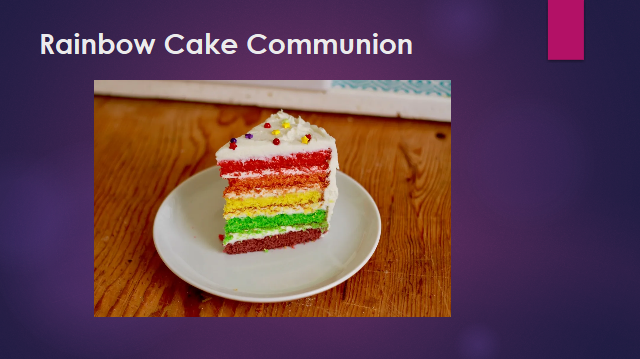
So when we share rainbow cake in a few moments, I want you to understand what we’re actually doing.
In Christian communion, the bread is broken – body and blood, sacrifice and remembrance. It’s powerful theology. But this rainbow cake? This is different.
Cake is what you make for birthdays. For weddings. For moments when you want to mark: Something precious exists in the world and deserves to be honored. We don’t make cake for mourning. We make cake for declaring: This is worth celebrating.
This rainbow cake – dyed with the colors of Pride, the visible spectrum itself made edible and sweet – is about uncovering. Making visible what was always there but required the right conditions to be seen.
The rainbow isn’t arbitrary. It’s what happens when white light passes through a prism and reveals all the colors that were there all along, invisible until something made them visible.
That’s the full spectrum of human existence. That’s gender diversity. That’s all of us in our complexity – always there, waiting for conditions that let us be seen.
When you eat this cake, you’re not just expressing solidarity with queer folks. You’re making a physical pledge with your body: I refuse to participate in the burial. I commit to the uncovering – of you, of others, of myself.
You’re saying: I see you. I see the full spectrum. I will not pretend humans are simple. I will not collaborate with the concrete.
And you’re saying: This existence- our existence – this complex, colorful, refusing-to-be-categorized existence – is worth celebrating. Not tolerating. Not defending. Celebrating.
Because just like those stones on Waikiki Beach – when we gather and make visible what’s been buried, when we refuse to let shame and fear keep truth hidden, when we choose celebration over erasure – something divine shows up. The mana of those ancient healers. The power of every ancestor who insisted on being seen. The holy spirit of becoming itself.
Present. Here. In this room. In this cake. In us.
—
So I invite all of you – queer and not-queer, trans and cis, whoever you are in your becoming – to receive this cake as commitment:
A commitment to uncover what’s been buried in our communities, our culture, ourselves.
A commitment to see each other as whole, holy, and good – especially in transition, especially when becoming, especially when refusing to be simple. Because none of us are simple. We are am multicolored cake.
A commitment to celebrate the full spectrum of human existence.
Because we have a phrase in our movement, and I offer it now as blessing and truth:
All genders are whole, holy, and good.
Not despite transition. Not after we figure ourselves out. Not once we settle into neat categories.
Right now. In the complexity. In the becoming. In the mix of elements that makes each of us irreplaceably ourselves.
The stones were buried for decades. And yet they remained – powerful, present, waiting.
When activists finally demanded they be uncovered, cleaned, made visible again – the stones hadn’t lost their mana. The healing was still there. The testimony was still true.
You can bury something holy. But you cannot destroy it.
This is our work now: To uncover. To testify. To refuse to stay buried.
The stones testify: We are ancient. We are powerful. We have always been here.
The rainbow testifies: We contain multitudes. We are the full spectrum.
This cake testifies: We celebrate what refuses to be simple.
Our bodies, here together, testify: We are healers. We are holy. And we will not be erased.