Speaker & Worship Leader:- Maria Hayward
What does colonisation really mean and why should we, as Unitarians, care? Have you ever wondered what people really mean when they talk about the effects of colonisation? The korero today provides an example of embedded racism in the language of the colonisers – and asks what we can learn from this?
Read below, or download the PDF
Maria Hayward © 2 August 2026
Introduction to Colonisation
The chalice words are in honour of the Unitarian Universalist fourth Principle and were written by William Ellery Channing (an early US Unitarian – 19th c.).
“I call that mind free, which jealously guards its intellectual rights and powers, which calls no-one master, which does not content itself with a passive or hereditary faith, which opens itself to light, whencesoever it may come, which receives new truth as an angel from heaven”.
Preamble:
Rev Alec Toleafoa mentioned colonisation and its effects in his talk to us about the Polynesian Panthers last year. And Catherine Delahunty earlier this year shared with us the ongoing detrimental effects of colonisation on West Papua. Some of us participating in this service today have predecessors who were colonisers, mine were, and our home countries enjoyed the spoils (wealth) that accrued from colonisation. But maybe there are also a few in our group who are descendants of colonised peoples, and your ancestors might not have fared as well. In nearly all the colonised countries, indigenous people, even today, are more or less at the bottom of every social pile, so I wonder, what did the colonisers do to create these unequal societies? I decided to undertake a “free and responsible search for truth and meaning”, (principle 4 again, – the green one), because I wanted to understand more about the detrimental effect of colonisation. But this is an extensive field, and I’ve only covered the tip of the iceberg. One aspect of colonisation was the dramatic accrual of wealth by colonising countries and the corresponding poverty inflicted on indigenous groups. India was one of the wealthiest countries in the world at the time of the British takeover; by the time they left, it was one of the poorest. But another aspect of colonisation was the racist belief in the superiority of the colonisers. I’d like to share with you today the beginning of my journey into learning about how colonisation and racism had a damaging effect on the beautiful motu we occupy today – Aotearoa.
‘Linguistics’ is the study of language and is my field of academic learning. I applied this knowledge to a post-colonial text to see what I could learn about this period in Aotearoa. My kōrerō today provides a preliminary explanation of how language defines, frames and determines futures for people. Maybe you’ll see, as I did, how the language in this text clearly demonstrates the subtle (and not-so-subtle) ways that racism is perpetrated.
Kōrero
E ngā mana, e ngā reo, e ngā karangatanga maha, tenā koutou katoa.
I have a book that was purchased from the “Hard to Find Bookstore”, formerly in Onehunga, now in Eden Terrace, Auckland; Dowling Street, Dunedin. The book is an old children’s book (probably early 20th century), entitled: “The Wonder Book of Empire”, and, as you might have guessed, it’s about the Great British Empire. I looked at this book again recently and today’s homily is the outcome.
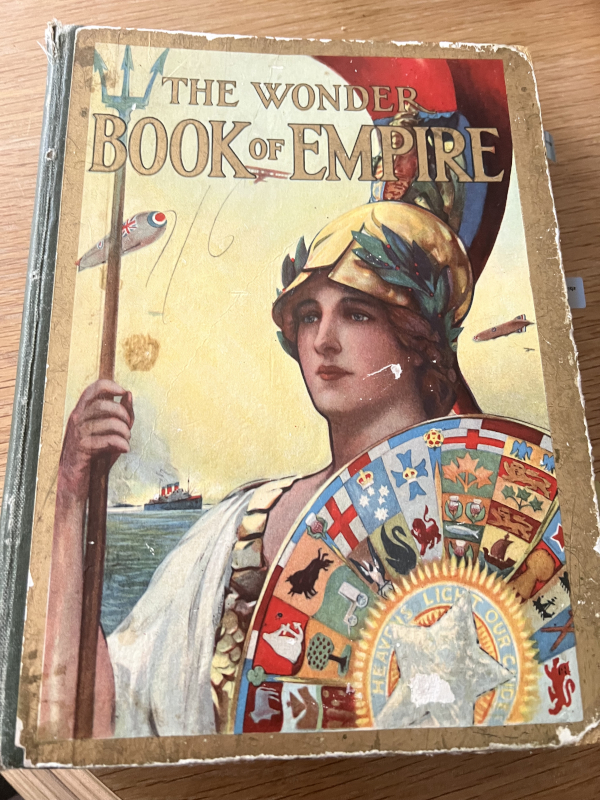
The book provides a very good representation of the cultural attitudes and opinions of the time, in particular, the attitudes towards colonised people and nations. I was interested in how Aotearoa and Australia were depicted and I was also keen to examine how, a possibly racist, colonial ideology was promoted and promulgated. I saw this racism and maybe you will too, as I relate some linguistic examples.
A key thing I noticed, was that although there were linguistic differences in the way the various (colonised) groups were described, all the colonised groups were designated much less favourable language than that used to talk about the British colonisers.
I need to begin by pointing out the language in this book, is actually what is called a “benign” model in colonial discourse. That is, the aim of the authors was not to demean or devalue indigenous people – it was supposed to show how interesting they were; but even that term is patronising, and indeed, so much of the language – even in this ‘benign’ form, is very denigrating – towards some nations more than others. Australian first people and African people are described in much less ‘benign’ language that employed for NZ Māori, but for today, I will focus predominantly on the descriptions of the tangata whenua of this motu – Aotearoa.
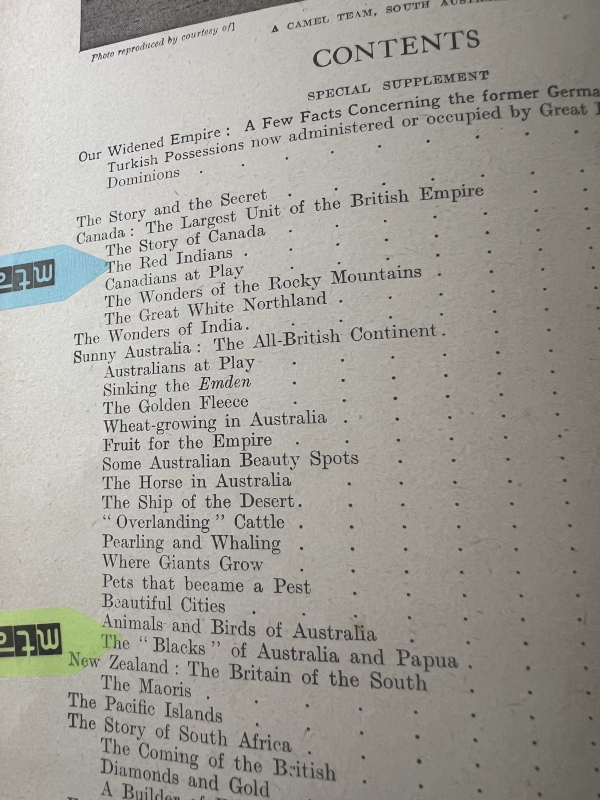
The book has chapters on 18 of the 61 British colonies. The chapter headings are interesting in themselves, and include, for example, the following titles: “The Red Indians” (of Canada) and “The Blacks of Australia and Papua”. These titles may already be making you feel a little uncomfortable – as what’s happened is that indigenous groups are reduced to just a colour, which is dehumanising and degrading. And it’s just plain racist. Racism is when one group talks of its own superiority whilst describing (directly or by implication) the other as inferior. Shane Jones made a similarly dehumanising comment a while ago, in referring to the largest population in the world as a cuisine item with his ‘butter chicken’ comment. And Winston Peters also made a racist generalisation which categorised Chinese-background people as a stereotype.
The book frequently refers to British “possessions”. Indeed, at the back of the book there is a list of the millions of colonised people who are described as being “possessed” by the British – and these figures, btw, include: nearly 5 million people in Australia, 315 million in India and 1 million people in New Zealand; plus, of course, millions and millions more people in the other ‘possessed’ nations. Btw, that 1 million people in Aotearoa was the population in 1908. Of these, only 20% were Māori. The Māori population had halved in number since the arrival of the British.
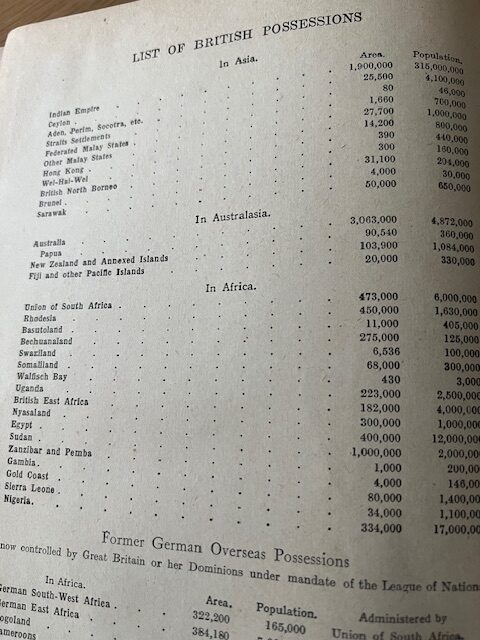
The authors of this book also claim that the British now “protect” the people of these lands. But the massive decrease in the Māori population doesn’t exactly attest to any degree of ‘protection’. Likewise, the decimation of almost an entire ethnicity in Tasmania does not indicate any level of protection whatsoever, yet these words are used in this book for children.
Let me now relate some other interesting linguistic exemplars used throughout the book – you’ll notice that colonised people are almost always depicted negatively or as inferior (which I’m sure won’t surprise you). But don’t forget, in tis motu, Māori had strong economic and social structures already in place when the British arrived. They had an advanced trading economy, a strong value and practice for passing on learning (matauranga) and women were much more equal in Māori society than they were in British society. Several Māori women were chiefs, and they signed the Treaty of Waitangi. Almost an equal number of their Gods were female and some were gender neutral.
Back to the book: I want to talk about nomenclature (or ways of naming people): the colonisers get very respectful nomenclature: They are called: “British adventurers”; “pioneers”; “brave soldiers” or the neutral term: “settlers”. But indigenous people in the book never get deferential or reverential language. They are called “natives”, “savages”, and as mentioned earlier, just “blacks”. In one instance, a group is labelled: “almost cannibals” – almost (I’ll tell you about that soon)!
When battles are described in each of the chapters, the British are almost always described as being “brave” and “glorious”, but the colonised people are described as being “vicious” and “savage” (these are the actual terms used). They’re both killing, but the British are brave and the indigenous people are vicious. Additionally, the British are said to: “advance on”, or to “break the power of the enemy”, whereas indigenous people might, for example, “raid” and “slaughter” people. (NB: Same actions, different language). If the British killed hundreds of people, the event is described euphemistically like this: “they crushed the authors of lawlessness” and in one chapter, there is this statement: it was a “glorious page in history … and …when that day was over, the dead (indigenous people) lay piled in heaps”. Yes, a horrible image and don’t forget, this is a book for children. But the indigenous people have already been ‘othered’ (via language constructions like “the blacks”, “the savages”) – and the children who are the readers wouldn’t be expected to feel the shock or sadness about the “people laying in piles” as they already see this group as ‘not the same as them’, maybe they are even considered barely human. Certainly, this is how the authors portray them linguistically.
The irony, in this text, is that it boasts about how many more indigenous people the British killed rather than the other way round. And this killing by the British is described as “subduing” the Māori, but indigenous people (who killed far fewer English), are said to “pillage” or “slaughter” the British soldiers. The absolute opposite taxonomies should have been employed.
Taxonomy is the word linguists use to describe lists of words in a category. You can probably already see the different taxonomies employed in this text. These linguistic terms and constructions embed in readers subtle perceptions of the respective groups – one is good, the other not so. What we should be wondering, is what happens to the mana, the self-esteem and the self-image of the group who are described negatively?
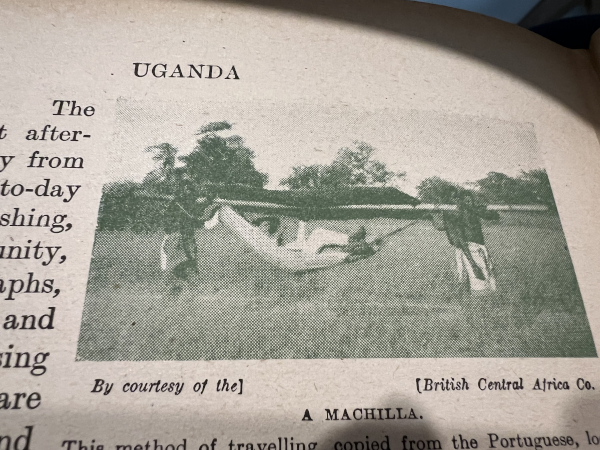
Another taxonomy in “The Wonder Book of Empire”, is that indigenous people are described as lazy or indolent. But then the writers also describe how the indigenous people “serve” the British and do hard labour for them. In one chapter, there is this depiction:
“The white men are carried about in Machillas, or hammocks, slung on bamboo poles” – there’s a picture, guess who carrying them? The writers continue: “It looks lazy” (for the white people) – “It looks lazy but is comfortable and rapid”. This statement clearly assumes the respective roles of masters and servants. And that it’s ok for white people to be lazy, but not for indigenous people.
Interestingly, Māori in this book are never referred to by skin colour. There is a weird statement that sounds like it’s supposed to be praising Māori, but – well .. what do you think: “The Māoris of New Zealand are almost the only native race that has survived wars with Europeans and shows signs of living as equals with them”. I don’t think I even need to deconstruct that – you can see it for what it is. Later, the book tells us how the ‘equals’ are not exactly equal …
There is an assumption in the book, that local people will be grateful to the colonizers; and, indeed, Māori are criticised for (quote) “objecting to white people occupying their land” as if this is surprising and unacceptable behaviour! Yet it says about Australian indigenous people that they apparently “have yielded their country to white settlers” and that “often they become greatly attached to their white masters” (yuk). And remember, I’m quoting from a benign example of colonial language – other examples are actually, much, much worse.
Is the language racist? As mentioned earlier, racism is the belief that one race is superior to another. That belief is exactly what the language I’ve quoted today demonstrates. So, yes, it is racist. Is it any wonder that with this notion of superiority that there has been an erosion of self-esteem, confidence and ‘mana’ of colonised groups. It’s a hard pill to swallow for those of us who are descendants of colonisers, but it’s important medicine if we want equity, justice and inclusion – (hey, our values!) – in this community and in the country we love.
I just want to make a further comment on the term ‘yielding’: In describing an attempt of the British to gain yet more land in Australia, the people who “did not yield” were, by the way, described as savages, and “almost cannibals” – yes, for not yielding their land!! But then, there is this statement: “the civilised ones did not resist”. (Interesting use of the term: ‘civilised’). Yielding to the British invaders, was considered civilised.
You can probably by now see the very subjective bias in this text – there is a lot of it. I’ll just share a few more examples: (quote) “On the whole, great progress has been made civilising and Christianising the British possessions in the Pacific (yes, that’s people they’re referring to). “In most of them, the natives are being encouraged to educate and improve themselves, but they all require Europeans as their leaders”!!
The language examples I’ve just relayed to you, is the language of colonisation. And although I am focussing on British colonisers in this kōrero (because of the book I am analysing), as you will know there were many colonising countries – and most had similar attitudes – and most managed to marginalise and impoverish indigenous or first nation peoples within just a few years, mostly through the massive theft of land and resources.
When the language in this text is more positive it is nearly always patronising and suggests the “natives” are happy with their subservient position. The Zulu people in Africa are even described as being “proud to serve their British masters”.
Interestingly, whilst simultaneously boasting about apparently bringing ‘civilisation’ as well as freedom and happiness to more than 60 nations, this book also boasts about the massive wealth accrued by the British from these colonies, and this is presented as evidence of their superiority. Contemporary research has analysed the amount of wealth accrued or stolen by the British. An analysis cited in a recent Oxfam report puts the figure stolen from India alone, at over $64 trillion (in today’s terms). This wealth transfer, identified as the “drain of wealth” by early Indian nationalists, was a systematic process that contributed significantly to Britain’s industrialization and to India’s impoverishment. In NZ, Māori owned 100% of the land at the time of colonisation, within just 20 years, they had lost 20% and by the mid 20th century, they owned only 5%. If paid fairly for this – they should have been extremely wealthy – instead Britain became extremely wealthy.
Although colonised nations weren’t always left with nothing. As Archbishop Desmond Tutu explained:
“When the missionaries came to Africa, they had the Bible and we had the land. They said: ‘Let us pray.’ We closed our eyes. When we opened them, we had the Bible and they had the land.”
There is so much to be said about colonisation.
When we become informed and also feel the pain of an oppressed group, the pain of colonisation, and if we also have a desire for virtue – for morally good behaviour, being informed is helpful. Knowing the truth is helpful. I need these reminders to keep me on track, to keep me fighting for social justice. When we feel something deeply, we have the potential to transform, to improve, to become better human beings. I think, maybe that is what connects all of us who are attending this service today. And maybe, like me, you might want to continue learning about colonisation and its negative impact. If so, let me know. Also, please let me know of any experts who could speak to us further on this.
No reira, tēnā rā koutou katoa.
Closing words
I wish to recite today an excerpt from Rev. Alec Toleafoa’s talk to us early last year about the Polynesian Panther group he was part of as a 15-year-old fighting for justice. I think what he said is inspiring. He concluded his talk with this:
So, what now?
Now, we preach.
We remember. Remembering is empowering.
We resist.
We make that one more courageous step,
That one more hymn, that one more prayer.
We make our protest a prayer and our prayer a protest.
To build that world we sang about earlier: “We’ll Build a Land”
‘Where justice rolls down like water and righteousness flows like a mighty stream’,
Because Racism still holds a pen, still writes policy, still knocks on doors at dawn.
But we….
We walk with memory.
We walk with courage.
And we walk with a different law
The law of aroha – love.
The law that empowers us to believe
another world is not only possible — it is already being born.
Let it be so.
(Rev. Alec Toleafoa, Unitarian Church, July 2025)
Meditation / Discussion Question starter
- What have you seen in your social, working, or everyday life that evidences colonialism?
- What can we as individuals do if we’re not happy with this?
Discussion rules:
- Keep your comments brief
- Ensure everyone has a turn (or passes)
- Listen, but do not comment (you can affirm with a very brief comment during your own speaking time)
- You can add a further comment if everyone has had their turn to speak
Links
Chalice Lighting:- from “Spiritual Freedom” (1830) by William Ellery Channing