Transcendence through the arts: what transports you?
Speaker & Worship Leader:- Rachel Mackintosh
Listen, or download the MP3
Listen, or download the MP3
Read below, or download the PDF
Follow this shortcut to the bottom of the page for the various readings, videos, etc. shared in the service.
Rachel Mackintosh © 26 July 2026
If you look at the kinds of things we say about ourselves in this Unitarian faith, you will often find reference to the fact that we don’t offer easy answers, or certainty, or the promise that an interventionist god will look after us.
There is a quote from Rainer Maria Rilke that elegantly sets out this aspect of Unitarianism:
“Be patient towards all that is unsolved in your heart and try to love the questions themselves, like locked rooms and like books that are now written in a very foreign tongue. Do not now seek the answers, which cannot be given you because you would not be able to live them. And the point is, to live everything. Live the questions now. Perhaps you will then gradually, without noticing it, live along some distant day into the answer.”
Today our topic is art and the ineffable.
By some irony, I will be using words to convey the ineffable: that which is too vast to be contained in words.
That’s okay.
Words have spaces between them.
Art takes many forms.
We can see art as merely pleasing; a simple rhyme:
Hickory dickory dock
The mouse ran up the clock
The clock struck one
The mouse ran down
Hickory dickory dock.
I say “merely pleasing”, as though pleasure is of little moment.
We come back and back and back to such simple pleasures, each revisit resonating with all the previous times we have heard that rhyme, looked at that painting, walked around that sculpture, heard that music …
Perhaps as you heard Hickory dickory dock just now, you were transported to a time when a parent could lift you swinging up into the air, or you had a tricycle that allowed you adventures, or blocks to play with, or you felt the softness of your first kitten.
I hope so, though of course some childhoods are darker, and dominated by layers of unhappiness. If that is your association, please stay with me, for every day on earth offers a new possibility. The space between every two days and every two words is full of possibility.
If hickory dickory dock evokes more painful memories, we still may come back and back and back, picking a scab.
What is “merely pleasing” in art can give our life shape, and provide layers that build to create our lives.
What evokes a painful past in art can also give our life shape, and provide layers that build to create our lives.
Living the layers, if not facing the questions.
If we look back to Eustace from our reading earlier, these simple experiences can be compared to his first attempt to shed his dragon skin:
“ … my whole skin started peeling off beautifully, like it does after an illness, or as if I was a banana. In a minute or two I just stepped out of it.”
Of course we know, since we heard the rest of the story, that Eustace wasn’t actually transformed by that first shedding of his dragon skin.
It took more for him to go further, to be transformed.
How can we go further? How do we go beyond the “merely pleasing” — or the revisited pain — to the transformational?
How can art let us experience what Eustace experiences?
“The very first tear he made was so deep that I thought it had gone right into my heart. And when he began pulling the skin off, it hurt worse than anything I’ve ever felt. The only thing that made me able to bear it was just the pleasure of feeling the stuff peel off …
“And there I was as smooth and soft as a peeled switch and smaller than I had been … I was very tender underneath now that I’d no skin on …”
And so he was transformed.
Let us now explore how art can be a source of our transformation, how art can lead us to go deeper, to find what is tender underneath.
Art and the ineffable.
Words have spaces between them.
Art takes many forms. Different people are drawn to different forms of art at different times.
For you, you may be drawn to visual art, where a painting or a sculpture arrests you.
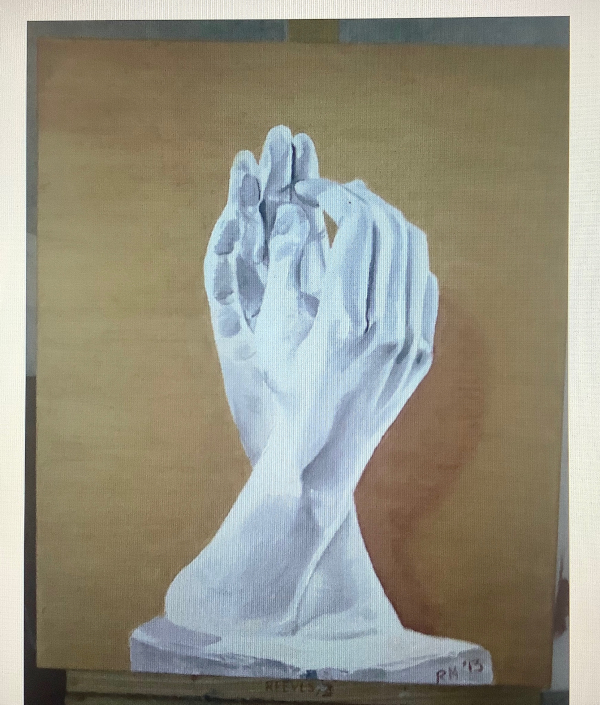
This sculpture, by Rodin, is called La Cathédrale — the cathedral. It is a marble sculpture of two right hands. You may have to look at it for a while to see that it is the hands of two people. The hands don’t touch. Only the space between them speaks. This is just a painting of the sculpture, but if you ever get the chance to be in the room with it, you can walk all around it and see that space between the hands from every angle.
The ineffable is there. The space between the hands.
You may be drawn to music. The beauty of what Frank and Jaime play for us this morning, including the spaces between the notes, may provide your space for transformation.
For you, it may be science. The exquisite beauty of a mathematical equation, of a chemical process, of the curve of a bridge. Tell me an engineer is not a poet and I will show you a bridge.
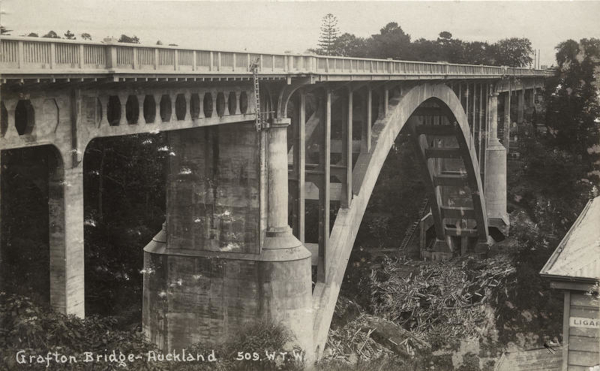
These things may start as merely pleasing, but the beauty can cut so deep that we feel it has gone right into our hearts.
For the art of literature, the spaces between the words are the place for us to live the questions, to be patient with ourselves, to simply be.
For me, one place for writing to contain the ineffable is where writers break rules.
James Joyce breaks rules at the very beginning of his work, The Portrait of the Artist as a Young Man:
“Once upon a time and a very good time it was there was a moocow coming down along the road and this moocow that was coming down along the road met a nicens little boy named baby tuckoo….
“His father told him that story: his father looked at him through a glass: he had a hairy face.
“He was baby tuckoo. The moocow came down the road where Betty Byrne lived: she sold lemon platt.
“O, the wild rose blossoms
“On the little green place.“He sang that song. That was his song.
“O, the green wothe botheth.
“When you wet the bed, first it is warm then it gets cold. His mother put on the oilsheet. That had the queer smell.
“His mother had a nicer smell than his father. She played on the piano the sailor’s hornpipe for him to dance. He danced:”
James Joyce well knows the conventions of story-telling. Here he breaks them. We, the readers, are transported … vertiginous … we are whirled around in his stream of consciousness … transformed … in this space, with our mind and expectations disrupted, we may experience something new … is this our full humanity?
A songwriter breaking the rules of rhythm also provides an opportunity for transformation.
Paul Simon has been writing songs for decades. He well understands how poetry scans:
“He’s a poor boy
“Empty as a pocket
“Empty as a pocket with nothing to lose
“Sing, Ta na na
“Ta na na na
“She got diamonds on the soles of her shoes”
So he knows what he is doing.
Then he does this:
“And I could say Oo oo oo
“And everybody here would know
“What I was talking about
“I mean, everybody here would know exactly
“What I was talking about”
This doesn’t scan. He just jams in all the syllables he wants.
The audacity! The disruption of our expectations.
Paul Simon just breaks the rules.
As if everybody here would know exactly what he was talking about.
Where does that leave us?
Where does it leave you?
Certainly it leaves me in a space in between.
I have one final example from literature.
“Nothing wondrous can come in this world unless it rests on the shoulders of kindness.”
This is a quote from the Barbara Kingsolver novel, The Lacuna. It is the last day of Leon Trotsky’s life. He is in Mexico City, where he is living in exile, studying, writing and being part of a local community. As part of this community, he mentors young people, and a young man has come to him with something he has written. The writing is shallow, derivative, unimaginative. Trotsky takes the young man and his writing seriously. He spends time with him discussing his thoughts. Because nothing wondrous can come in this world unless it rests on the shoulders of kindness.
Then on the next page the young man kills Trotsky with an ice pick.
The horror of the assassination hangs there in the air, juxtaposed with the timeless truth that nothing wondrous can come in this world unless it rests on the shoulders of kindness.
In spite of all the horrors of the world, when we are welcomed in community, with kindness, we can begin to experience what is wondrous. And these things don’t always happen in neat chronological order.
What tear have you felt that was so deep you thought it had gone right into your heart?
What has left you truly speechless? What art has produced the ineffable for you, so that you really are living the questions?
After his transformation, Eustace has turned from a dragon into a boy — he has become human again. As Rilke says, the point is to live everything. What in art transforms you so that you live everything, that you experience your deepest humanity?
Amen.
Meditation / Discussion Question starter
- What in art (or science) goes so deep you feel it has gone right into your heart?
Links
Opening Words:- “Art” By Ralph Waldo Emerson
Opening Words II:- “A spell to be used when addressing the birth of a child” By Ralph Waldo Emerson
Reading:- is from “The Voyage of the Dawn Treader” By C.S. Lewis
Closing Words:- “She asked me if she took one pill …” By Glenn Colquhoun, published in Playing God, Steele Roberts, 2002