Speaker:- Niki Harré
Worship Leader:- Ted Zorn
Religions have strange, implausible stories, that assume there is a secret depth that sometimes seeps – or bursts – into ordinary life. While I have never ‘believed’ in an enchanted world, people thrive when they see beauty and meaning in what surrounds them. And that’s a creative process that requires unknowns and surprises. This talk explores the role of enchantment in contemporary life.
Listen, or download the MP3
Listen, or download the MP3
Follow this shortcut to the bottom of the page for the various readings, videos, etc. shared in the service.
Read below, or download the PDF – to come.
Niki Harré © 27 September 2026
Thank you for the invitation to speak today.
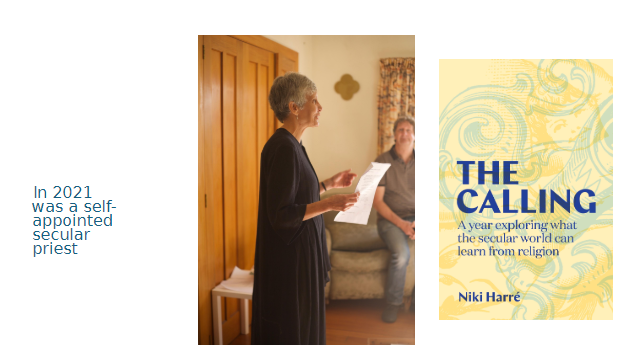
I am a community psychologist, and an atheist and in 2021 I undertook what could be called action research in which for a year I a) investigated Christianity and a) was a secular priest.
To be clear, it was a role I made up.
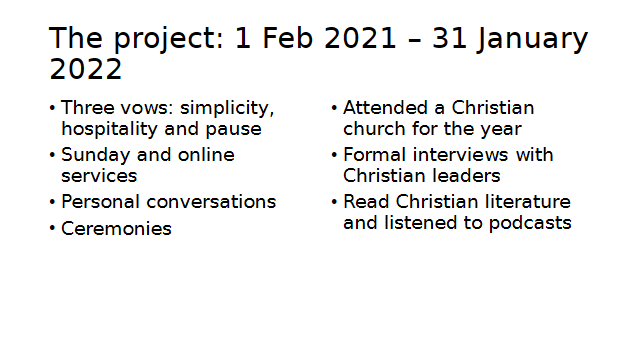
I had three vows: simplicity, hospitality and pause.
I offered three Sunday services a month, followed by an online service at 7am on Wednesdays on the same theme.
I also offered personal conversations in which people were invited to explore with me one-on-one how to deepen their contribution to collective life.
And I offered ceremonies for life transitions.
Attended a Christian church, Rhythms of Grace, for the year
Formal interviews with Christian leaders
Read Christian literature and listened to podcasts
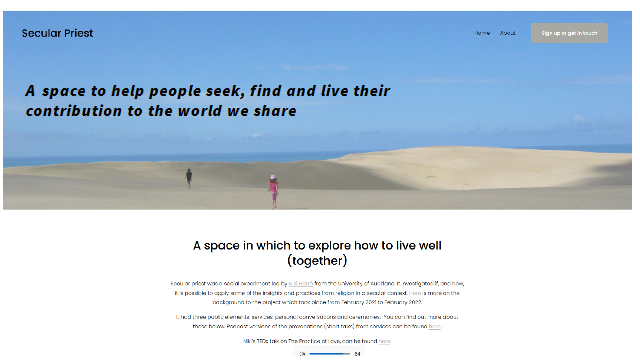
I advertised my offerings through a website secularpriest.org with the initial byline: A space to help people seek, find and live their contribution to the world we share.
The purpose, as in the subtitle of my book, was to explore what the secular world could learn from religion – with Christianity being the religion of my cultural heritage and so the one I explored in depth.
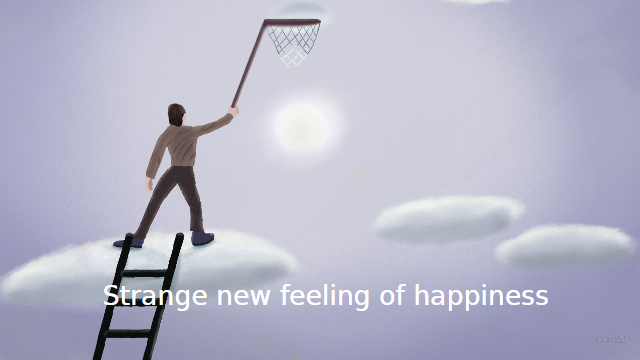
One unexpected finding of the project, was that after a few months I experienced what I dubbed a strange new feeling of happiness that gave me a feeling of spaciousness and allowed me to live in the present without fretting over the past or what was to come.
One of its characteristics was the feeling that I had time, an absence of rush or restless indecision. It was, I think, a kind of ‘enlightenment’ that simply came to me – grace perhaps. I had two bouts of this, the first lasted for 61 days, and the second for about a month.
When I was in it, I was able to ‘catch it’ if it started to drift, as long as I was attentive. I think the reason I lost it each time was that I got so caught up in daily life that I forgot to attend to it.
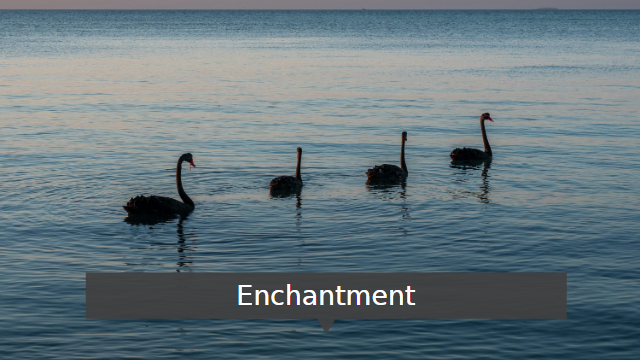
Another and the focus of today, was that I observed and experienced an enchanted world.
One July day in my secular priest year, I went for an early morning run. A little way along the beach near my home, there was a group of 30 black swans about 50 metres out on the water. The moon was full and the pre-dawn clouds a delicate pink. It was like a scene from another dimension: silent, stunning, and never to be repeated. I ran on, until after about 50 metres, I felt a sudden pain in my calf and was forced to turn around. It felt like I’d reached the edge of a magic circle and been pulled back. The day continued with other numerical coincidences and social encounters that seemed aligned, as if I was part of a normally invisible pattern. For example, I noticed myself going 94kms an hour in a 80km zone on my way to church. Then, during the service the pastor told a story of being given a ticket for going 64kms an hour in a 50 km zone.
He didn’t try and get out of it by explaining to the officer that he was on his way to church, as he didn’t want to bring the church into disrepute.
While that day was special, I increasingly noticed and recorded mysterious alignments, and it was hugely enriching – like moving from a landscape of black and white to one of colour.

This wasn’t the first time I’d experienced enchantment. In November, 2015, I watched a man become a kangaroo. I was in Kurri Kurri, New South Wales, Australia. The traditional custodians of this area are the Awabakal and Wonnaruapeople who I acknowledge today and pay my respects to their elders past and present. I was in Kurri Kurri for an conference on land that is now occupied by Hunter TAFE, a technical institute.
The campus at Hunter TAFE has one unusual characteristic, at least for a New Zealander, it is covered in kangaroos. They wander in from the bush in order to feed on the grass and sometimes you can see several at a time in different locations.
On the second night of the conference we experienced an Aboriginal smoking ceremony, led by four men, in which we each had a turn at being enveloped in the smoke of a smouldering eucalyptus branch.
The men then performed a series of dances, and that is when it happened. Almost all the dances involved the men moving like particular birds and animals. Then, in one dance, suddenly, one of the men was no longer a man – instead we were in the presence of a kangaroo, a magnificent animal of extraordinary grace and alertness. His arms became short front legs that allowed him to balance on the ground as his powerful back legs propelled him forward with seemingly no effort. When he stood up, he looked around with the relaxed intensity I’d seen in the kangaroos on campus – I am taking it the world in, he seemed to say, but it does not surprise me.
Of course you had to be there – and maybe you had to have recently watched and been enchanted by kangaroos as I had been. But what I felt, in that moment, was that I was in the presence of a “thin place” on Earth. Afterwards I was chatting with another woman at the conference who said she had also experienced this moment of transformation. So it wasn’t just me.
Thin places were described to me by Rod Oram as a place “where one can sense the divine more readily.” Holy sites, the destination of pilgrims, mountain tops, moments in which space, time and individuals identities, dissolve and re-connect in strange ways. Who knows what makes places or moments thin, perhaps it is simply the continual human intention that they be thin. A story that enacted over and over and over until it is true, at least for the people prepared to step into or caught unawares as I was.
For those few moments in Kurri Kurri the fact that I and others there were human seemed almost arbitrary – we could just as easily be animals or trees or the wind. I saw the world as fundamentally all of the same stuff, and our being – as people or animals or whatever – as manifestations of that stuff; manifestations that can, in certain intersections of place, time, mind and companionship transform into a different shape. It it was as if those of us watching the dancers had been offered the chance to “slip through” on the coat tails of people who had learnt from their elders how to observe the land and its life forms then somehow resonate them through their own, human, bodies.
In her book When God Talks Back, the anthropologist, Tanya Luhrmann, writes of evangelical Christians in the USA who experience God and Jesus as speaking directly to them, often via signs like my black swans or small gold cross, or the parked hearse.
She describes them as navigating an ‘epistemological double register’ in which they take their experiences as simultaneously real and a kind of play.
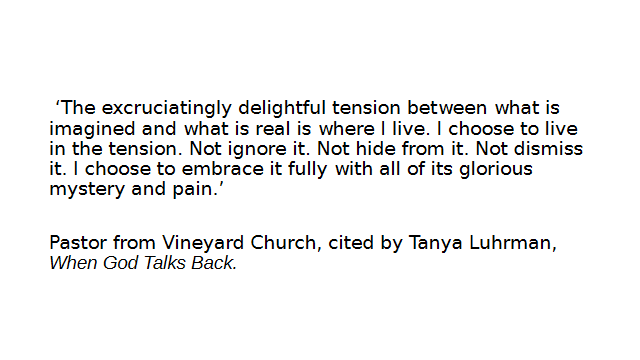
Luhrmann cites a pastor from the Vineyard Church she attended as saying: ‘The excruciatingly delightful tension between what is imagined and what is real is where I live. I choose to live in the tension. Not ignore it. Not hide from it. Not dismiss it. I choose to embrace it fully with all of its glorious mystery and pain.’
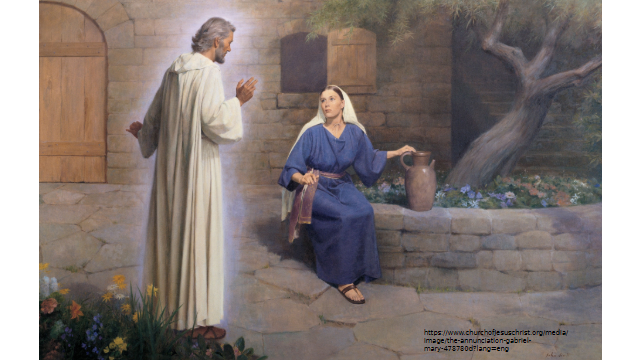
The enchanted world is woven into all religions with their, strange, implausible stories, that assume there is a secret depth that sometimes seeps – or bursts – into ordinary life.
Last time I talked with you, I described hearing the story of how Mary was informed by the angel Gabriel that she would carry God’s child on my first visit to Rhythms of Grace.
As I said then, what I mostly found jarring, was not the supernatural element, but the disturbing feeling that a teenage girl was being invited into the bedroom of a patriarch.
But the supernatural element is very strange indeed – as are other elements of the Christian worldview – Jesus as both fully human and fully divine, his power to heal and raise from the dead. And, of course, Christianity is not alone in its assumptions that the material world is not all there is – Buddhism for example, assumes reincarnation.
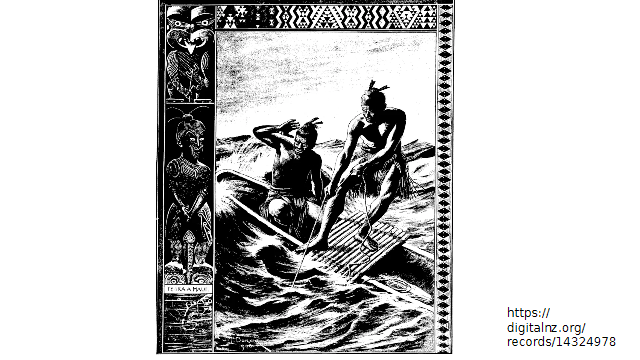
And indigenous worldviews are full of stories that tell of impossible but poetic feats: such as when Maui hid inside his brothers waka and used a fishhook made from jawbone of his ancestor, Murirangawhenua to fish up the North Island, Te Ika a Maui, with the South Island being Te Waka a Maui.
It is clear from the history of Christianity that in medieval Europe at least, people were assumed to be extremely porous constantly being affected by holy objects and rituals as well as curses and demons.
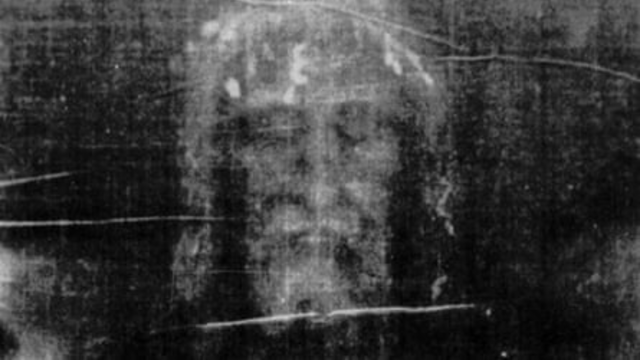
At least as described by the author Charles Taylor, in his book The Secular Age, these were thought of as real forces that got into people. For example relics, such as the body parts or clothing associated with Jesus or saints had healing powers – you didn’t have to “think” in a particular way, you just had to touch this object for it to work. Similarly demons had to be evicted you couldn’t just psychologically defend yourself against them.
This is the Shroud of Turin, which is reputed to be the burial shroud of Christ.
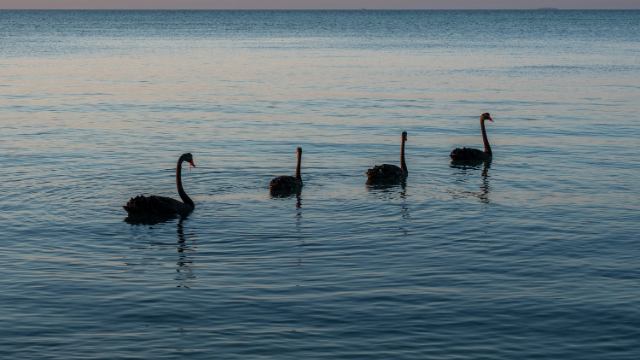
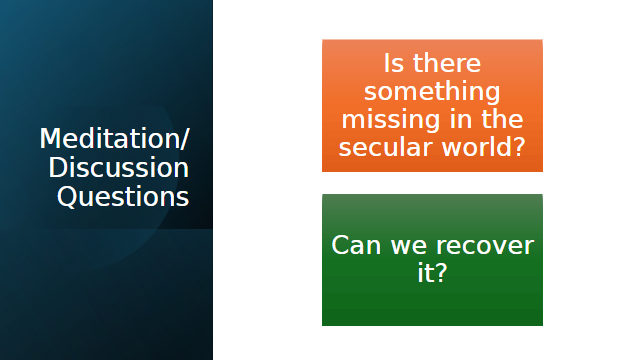
While I never ‘believed’ in my enchanted world, I think secular life is diminished by insisting that ‘the delightful tension between what is real and what is imagined’ is pure fabrication.
While we are moved by theatre, music, art, natural beauty, poetry and astonishing coincidences, we are firmly told that evidence and rationality are the foundation of human progress and progress is the name of the game.
My discipline of psychology is one of the culprits. Scientific methods and evidence-based practice are our gold standard, as if one day we’ll produce the definitive manual on crafting the perfect person.
To me, while scientific research is useful for understanding the human condition, it can divert us from a more pressing truth: that people thrive when they see beauty and meaning in what surrounds them. And that’s a creative process that requires unknowns and surprises.
The Christian texts I read, services I attended and people I got to know, assumed a presence or dimension that is far beyond our ability to understand. This invites open-ended meaning-making in a world that is more than it seems and, I suggest, enriches our lives together.
Links
Opening Words:- “Mysteries, Yes” by Mary Oliver
Reading:- is from “The Sense of Wonder” by Rachel Carson
Closing Words:- from “The World As I See It” by Albert Einstein