Service Leaders & speakers:
Barbara Thomborson, Karn Cleary
Today we’ll celebrate the Spring. The Equinox happens on September 23rd. marking a moment of balance before we transition into summer with longer daylight hours. This is an opportunity to consider what we want to leave behind in the darkness of winter, and how we will grow our hopes for the coming summer.
Listen, or download the MP3
LIsten, or download the MP3
Follow this shortcut to the bottom of the page for the various readings, videos, etc. shared in the service.
Read below, or download the PDF
Barbara Thomborson, Karn Cleary © 20 September 2026
How the Equinox is measured when the Earth is in Balance – Karn
This is going to be a very short talk, as I expect all of us know what the Equinox generally refers to, the day when we experience equal hours of daylight and dark.
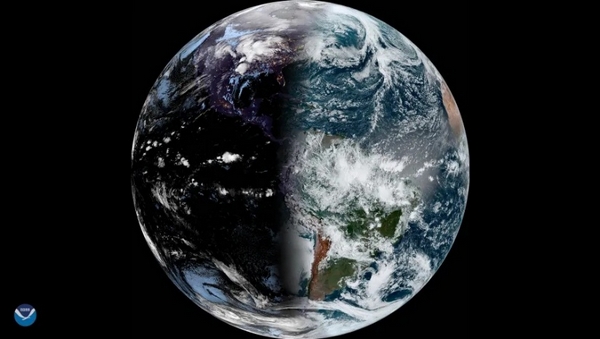
This is a photo of Earth at the moment when the sun is directly above the Equator, and both the North and South poles are in sunlight.
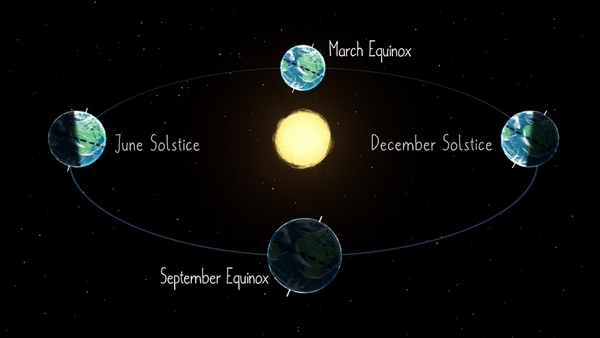
This shows the Earth relative to the sun, and how the tilt of our axis affects hours of sunlight at different times of the year; so we have two Solstices when the sun is at the furthest point from the equator, and two equinoxes as she is directly over the equator. It’s that moment of balance that marks the astronomical Equinox, which is used to mark the official beginning of spring or autumn, this year on the 23rd of September at 1205 in Auckland.
We have however already experienced the two days in spring when daylight hours match nighttime – yesterday and today in Auckland, as we are south of the Equator. This happens because of the way our atmosphere affects how light from the sun reaches the earth. The Sun itself is a sphere and not a point light source, so its edge is refracted by our atmosphere as it rises and sets, which adds several minutes of light to every day. The Sun doesn’t neatly wink on and off at sunrise and sunset like a light bulb, and so there isn’t a perfect split of day and night on the equinox – but it’s very close.
The days have been getting noticeably longer and warmer for a few weeks, which will continue until we get to the summer solstice in December, a few days before Christmas. The Equinox is just a moment, but spring is a time of transition that stretches over months. We’ve had early spring flowers blooming since mid-winter, the Taiwanese cherry tree which feeds our neighbourhood tui was spectacular all though August, and now the plum trees are blossoming. The birds have been busy too, searching for suitable nesting spots. The tui uses our totara tree, and discourages all other birds from coming near. I’ve noticed a female blackbird trying various spots around our house, I’m hoping she found somewhere safer than the outside light in our front porch where we noticed an abandoned nest a couple of weeks ago. Soon we’ll be seeing different flowers, and fledgling birds as summer comes closer.
Equinox as a time of transition and growth – Barbara
Spring equinox: the time we move from winter’s hibernation, ‘down time’, darkness and starkness, and transition to a time of awakening, more daylight, colour, and growth. The Maori goddess HINE-NUI TE PŌ is a good example of a personal transition from innocence to power.
This Maori hine-nui, meaing great woman or goddess, underwent a dramatic transition and transformation to become one of the most important hine-nui. She is HINE-NUI TE PŌ; the goddess or mother of the night, of death, and of transformation. This is a story of how she went from being Hinetītama, goddess or maiden of the dawn, to the mother of the night (PŌ).
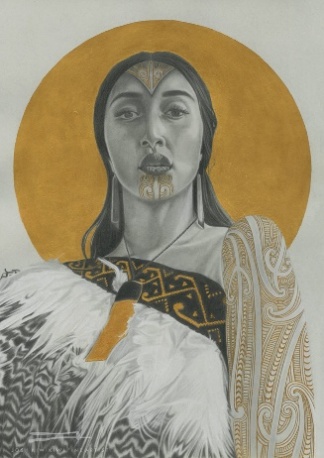
by Josh Kiwikiwi
Every day, Hinetītama woke with the dawn chorus of the birds, before the sun rose. She enjoyed her role as maiden of the dawn and was always happy to be the first up. She was the daughter of Tane Mahuta and Hineahuone, the first woman in Maori creation stories.
However, without telling Hinetītama of their connection, Tane Mahuta (god of the forest, of light, and knowledge) pursued Hinetītama and married her. They had several children. As she grew older, Hinetītama’s curiosity to know who her father was became strong, so she asked Tane. Tāne told her to ask the posts of the house, and she soon discovered that her husband was also her father. Overcome with distress, shame, and humiliation, she decided to leave the world of light (Te Ao Mārama) and fled downward to the underworld (Rarohenga or Te Pō). Before leaving, she told Tāne to stop his pursuit of her: “Return and raise our offspring in the world of the living; leave me here to draw our offspring down below.”
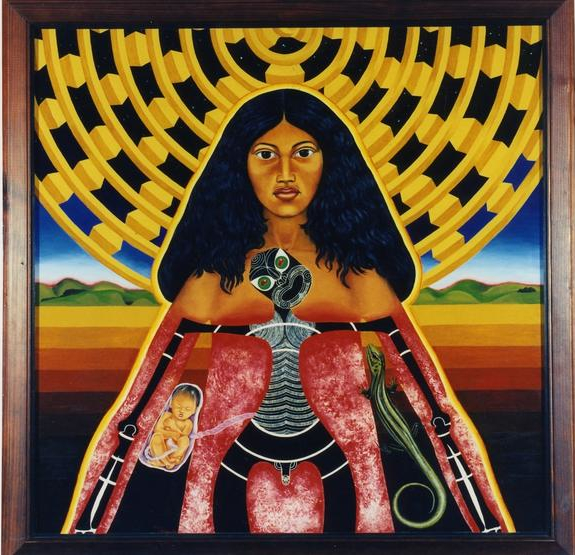
by Robyn Kahukiwa
In the underworld, her shame and anger at being deceived drove her to will her body to undergo a painful separation as Hinetītama into Hine-nui-te-pō (the goddess/mother of the Night). Thus, she transitioned and transformed to become the goddess or mother of the night and the guardian of the spirits of the dead.
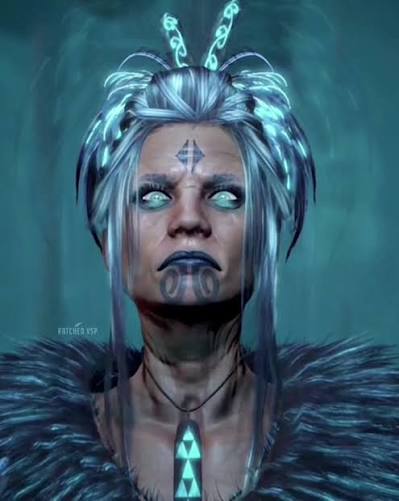
from Guardian Maia video game
Traditionally Maori described Hine-nui-te-pō not as compassionate guide of spirits to Te Henga Wairua (the launching spot of dead spirits from Cape Reinga); instead, they thought of her more as a consort to Whiro, the evil god of darkness and death. In this excerpt by the great author Witi Ihimaera, he attempts to redeem the traditional stories of Hine-nui-te-pō as something to fear so that we would stop conflating her with Whiro:
[We hear of her] “not as mother of Te Pō (the night) but, rather, as a malevolent goddess of sex and death. It was this frightening atua [goddess], the antithesis of life, that traditionally became [how we see her]. Perhaps, though, we could conclude that Tāne’s treatment of her was the cause of the transformation from the innocent young woman [to the frightening atua]: . . . like many a victim, was this how she now felt about herself: defiled, despoiled, monstrous? Maybe she had just had enough of being the passive victim and wanted to be a badass.
[Navigating the Stars: Māori creation myths; Witi Ihimaera, 2020]
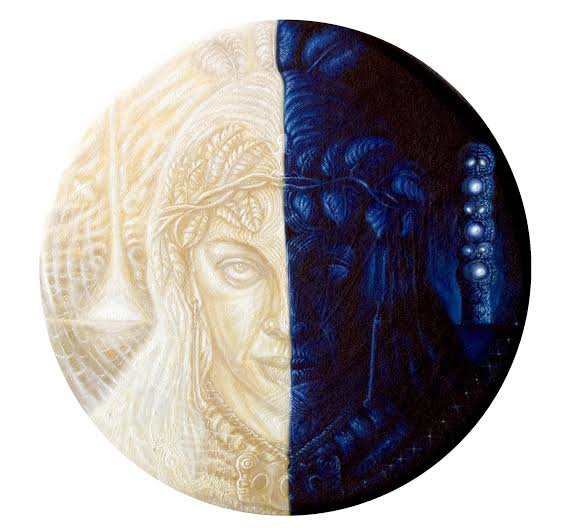
Unattributed, from Facebook
In any case, her transition and transformation from Hinetītama to Hine-nui te po established the mortal fate of humankind. These last 2 slides illustrate well not only the equinox (above) but Hine-nui te po’s change and growth from an angry, innocent young woman into a gentle, benevolent guide of the spirits of the dead into the underworld (below) – a true mother te po and of Rarohenga.
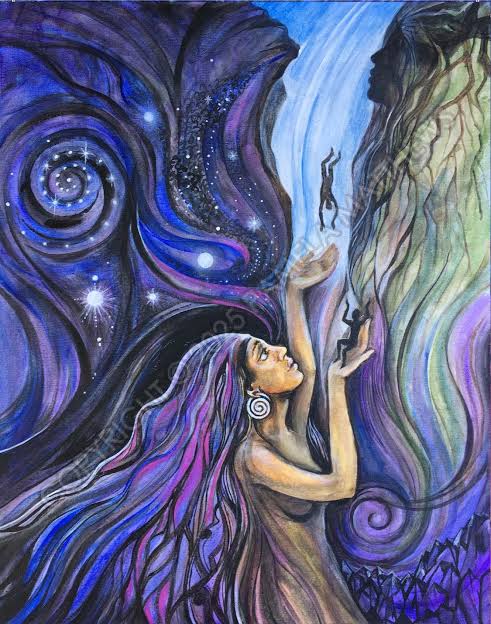
by Pamela Matthews
Meditation
Spring is a time of transition, as we come out of the cold, dark days of winter and begin to notice the changing light and warmer days. It’s a time of abundant growth and hope. Please take some time to consider what in your life you might be glad to leave behind with winter, and focus on what you hope for in the coming year……………………
Would now please write one or two words on the popsicle stick that was on your chair to express what you’re hoping to grow, & keep it with you till after the service.
After Frank plays the postlude, please come and take a pot from the table. Put your stick into the mix, take it home, water gently and plant it.
Links
Opening Words:- adapted from “Call to Worship on Easter” by Elizabeth M Strong
Chalice Lighting:- “Chalice lighting for the Spring Equinox” by Yvonne Aburrow (they/them), an English Unitarian
Reading:- “The trees” by Philip Larkin in Complete Poems of Philip Larkin, Faber & Faber, London 2014
Reading:- “A little Madness in the Spring” by Emily Dickinson
Reading:- “A Purification” by Wendell Berry from New Collected Poems. Penguin © 2012.
Closing Words:- by Roland Morin from Rejoice together, Skinner House Books, Boston, 2006