Speaker & Worship Leader:- Rachel Mackintosh
Video to come
Audio to come
Follow this shortcut to the bottom of the page for the various readings, videos, etc. shared in the service.
Read below, or download the PDF
Rachel Mackintosh © 7 September 2025
To Tomorrow, 1 September, is the first day of Spring in Aotearoa. Some countries date the seasons to equinox and solstice. We, more prosaically, date our seasons to the beginnings of months. Thus, 1 December is the first day of Summer, 1 March is the first day of Autumn, 1 June is the first day of Winter.
And tomorrow, 1 September, is the first day of Spring.
The first day of spring, whenever we fix it, is one day in the seemingly endlessly repeated revolutions of our planet. We mark the seasons with fixed dates to give our lives a predictable rhythm.
We may steal a branch of apple blossoms in the night, to give ourselves stars and the gift of Spring perfumes.
We may have less criminal rituals that underline our comfort at the repeating rhythm, rituals to mark the transition from one season to the next.
We watch for signs of Spring. The magnolias come early here and are just beginning to turn to leaf when Spring begins; already in full swing are the spring bulbs that have been speaking of hope since our midwinter. We watch now for roses. We anticipate the kōrari — the flower stem of the harakeke or flax, feeding the tūī and other nectar-loving manu or birds.
We wait for the day we can walk bare-armed in a warmer sunshine.
These are the seasonal signs of the spring blossoming of a temperate climate. These are the moments of transition.
In my opening words, I quoted Joseph Santos-Lyons: “… we name the water we swim in, even when it is bitter, and be braver than our reflexes, more committed than our fear.”
The transition to Spring happens every year. Today, we mark this transition in anticipation of tomorrow. Let us also consider larger transitions, transitions that may not repeat.
Let us name the water we swim in, even when it is bitter.
We are in the midst of a massive transition.
Indian writer Arundhati Roy said this about our recent experience of Covid-19:
“It casts a different light on the lives we have lived so far. It forces us to question the values we have built modern societies on — what we have chosen to worship and what to cast aside. As we pass through this portal into another kind of world, we will have to ask ourselves what we want to take with us and what we will leave behind. We may not always have a choice — but not thinking about it will not be an option. And in order to think about it, we need an even deeper understanding of the world gone by, of the devastation we have caused to our planet and the deep injustice between fellow human beings that we have come to accept.”
[https://www.goodreads.com/quotes/10673306-as-the-covid-19-pandemic-burns-through-us-our-world-is]
Arundhati said this a few short years ago.
What we know now is that that the world did not take that portal between the pre- and post-covid world as an opportunity to take stock of the devastation we have caused to our planet and work to right it. The world did not cease to accept the deep injustice between fellow human beings.
The transition did not bring the hope and perfume of Spring.
Instead the transition saw massively increased wealth concentration in the hands of a few. In a 2022 Oxfam article we learn:
[https://www.oxfam.org/en/press-releases/ten-richest-men-double-their-fortunes-pandemic-while-incomes-99-percent-humanity]“The world’s ten richest men more than doubled their fortunes from $700 billion to $1.5 trillion — at a rate of $15,000 per second or $1.3 billion a day — during the first two years of a pandemic that has seen the incomes of 99 percent of humanity fall and over 160 million more people forced into poverty.
‘If these ten men were to lose 99.999 percent of their wealth tomorrow, they would still be richer than 99 percent of all the people on this planet,’ said Oxfam International’s Executive Director Gabriela Bucher.”
[https://www.oxfam.org/en/press-releases/ten-richest-men-double-their-fortunes-pandemic-while-incomes-99-percent-humanity]
That trend has not improved since 2022, including in Aotearoa, where the wealthiest 119 families increased their wealth from $95bn to $102bn in the past year, over which time Auckland council reports that the number of people living without shelter increased from 426 to more than 800.
Eight hundred is a number. For us in this congregation, the number is made real when we see the sleeping bag and corrugated cardboard makeshift mattress of the person who sleeps in our porch. Maybe we see the person themself, one human life.
One among many. One of 800.
The transition did not bring the hope and perfume of Spring.
The transition did not bring the hope of a climate-friendly future. Currently the largest economy on earth — the United States — favours irreplaceable fossils to fuel their future, as does Aotearoa, where proposed road user charges will make gas-guzzlers more economical and electric vehicles less economical.
We are on the brink of Spring. It is easy to feel helpless, and to think that our only assuagement can be found in beer and circuses, or beer and crocuses, as the case may be.
I don’t feel helpless. I believe in the words of Joan Baez: “every day on earth is an other chance to get it right.”
I believe that every day we have a choice.
There is another voice of hope for us. Ursula Le Guin says this about the forces driving inequality and climate destruction:
“We live in capitalism. Its power seems inescapable. So did the divine right of kings. Any human power can be resisted and changed by human beings.”
We are in the midst of a massive transition.
Let us name the water we swim in, even when it is bitter. We are in a transition in climate, a transition in wealth distribution, a transition of people in our city to living without shelter.
We are part of these transitions, and any human power can be resisted and changed by human beings.
So, how can we resist and change?
We make the road by walking. How we do it will be what we get.
If we choose to combat the injustice we see with hatred and bitterness, we will create more hatred and bitterness.
If we choose instead to build a beloved community, we begin to make the road by walking, by this step, we begin to make it a road to justice in this massive transition.
So, how do we build a beloved community?
We build a beloved community first by knowing who we are — we are people who commit to each other and to the values and principles of Unitarian Universalism.
And once we know who we are, we can take the risk to be open and welcoming of anyone who chooses to join us, anyone who sees who we are and wants to be part of our community.
And then, because a congregation of 60 or even 100 or 200 people can’t create justice alone, we can take another risk and be open to relationships with other communities who know who they are.
Our Peace and Social Justice Committee, through charitable work, is supporting many individual lives and contributing good to our world, among other things supporting Médecins sans Frontières, Kids Can and a literacy project for people in the pacific and in Aotearoa.
This week we joined with two neighbours, not just for the sake of friendship, and not for charity, but to work for justice for homeless and low-paid people. As members of Te Ohu Whakawhanaunga, we and Merge Cafe and All Saints Ponsonby brought people to our church to speak of their experiences and their knowledge of poverty and of homelessness. We brought people together to ask candidates for public office to hear those experiences, and to commit to supporting policies that will alleviate homelessness and lift wages.
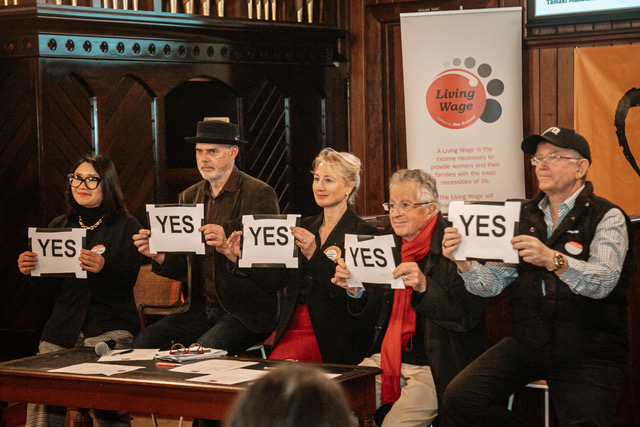
All the candidates who are likely to be elected said “yes.”
We are on the brink of Spring and through our membership of Te Ohu Whakawhanaunga we are acting to create a beloved community, to work with allies, to create justice.
We are making the road by walking, knowing that any human power can be resisted and changed by human beings …
What we are doing and asking is only reasonable, for people to have shelter and enough income to thrive. What we are asking is reasonable, but may also look revolutionary, when homelessness and poverty seem so deeply ingrained in our society.
Our revolution is one of building a beloved alternative and inviting people to take part. Our revolution is only reasonable.
Another thing that Ursula Le Guin has said is this: “You cannot buy the revolution. You cannot make the revolution. You can only be the revolution. It is in your spirit, or it is nowhere.”
Let us, Auckland Unitarians, make the road by walking, let us walk together into Spring, let revolution for justice be in our spirit, or it is nowhere.
Amen
Meditation / Conversation starter
- What do you offer to, and what do you need from, a beloved community?
Links
Opening Words:- by Philippine-based Unitarian minister Joseph Santos-Lyons
Chalice Lighting:- “Why We’re Here” By Erik Walker Wikstrom
Reading:- An excerpt from the poem “Proverbs and Songs”, by Antonio Machado
Closing Words:- “Spring” By Mary Oliver