We invite people of all ages to join us for our intergenerational service:-
this Sunday, 18 April, at 10.00am at the church, to celebrate Earth Day.
The children will perform and lead us in a sing-along and there will be a few surprises — ways for us all to honour and celebrate our home planet. So come and join in the fun!
Sankofa comes from the Twi language of Ghana in West Africa. A common English translation is “go back and get it.” The sankofa bird is an example of adinkra. Adinkra symbols make up a highly symbolic language—similar to Egyptian hieroglyphics. They are common among the Akan people of Ghana, and have made their way into the wider African diaspora. The symbols express complex thoughts and proverbs. The sankofa bird’s head faces backward as it attempts to catch its lost egg in its mouth. Its feet face forward. One translation is, “It is not wrong to go back for that which you have lost,” or “that which was taken.” Learn your past so that it may guide your actions in the present for the purpose of shaping the future. Another translation: “remember the past to protect the future.”
Whether it is a story about Rip Van Winkle or A Wrinkle in Time, sentient and self-aware beings cannot escape their enchantment with time. It wasn’t only Unitarian Charles Dickens who used time travel as a device to offer Scrooge redemption by visits to his Christmas’ past, present and future. Time like threads woven into the warp and weft of our lives connects us and all that followed the big bang. Tracing those threads as we seek to know where they lead has been a human endeavour since the ancient past.
We have decided to hold regular Whanau/Family Gathering Days throughout the year and invite you to join us. Unitarian spirituality is all about connection and building community.
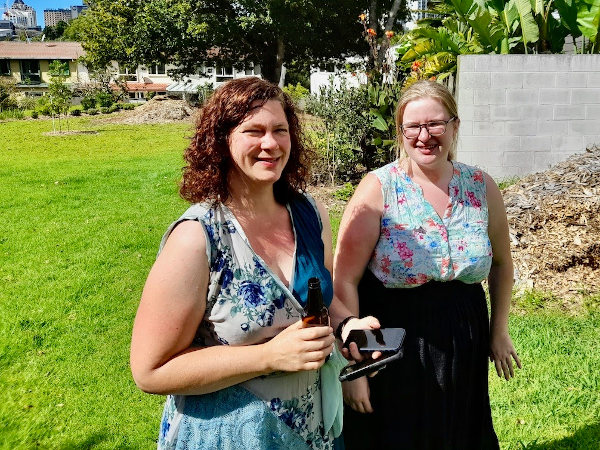
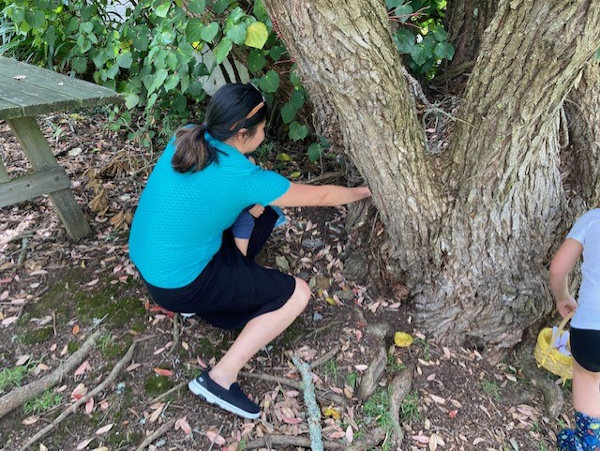
Our first Whanau Day was held this Easter Sunday, 4 April 2021 (see slideshow below). The whole congregation were invited to a nearby member’s home and in the park behind their house, to play, share food, music, conversation, and, of course, to hunt for eggs.
There is no getting around it. Our rationalist faith doesn’t “get” Easter. We get Christmas. Jesus was born. We get Good Friday. Jesus died. We don’t get Easter. If we think about it at all, we struggle with the idea of resurrection. Our first reaction is to dismiss what we don’t understand or can’t relate to. Even if we know the stories about Jesus’ last week in Jerusalem, what Christians celebrate as Holy Week, they can feel old, dusty and irrelevant to our lives. Too much suspension of disbelief is required to take them any more seriously than fairy tales. As a result, many Unitarians find Easter as empty of meaning as the tomb. Why bother going to the effort to roll back the stone? There is nothing to see … or is there?
Lifewise Merge Café located in Ponsonby near the Auckland Unitarian Church, sent out a call for financial help in March this year. The Café has taken a huge financial hit due to impact of the four Auckland Covid-19 lockdown periods, and was in danger of closing.
I have a bone to pick with my daughter. In a recent FaceTime call she was appalled to learn I wasn’t familiar with a TV series called The Walking Dead. I reminded her that I do do dragons and wizards — and werewolves if Michael J Fox is one. I don’t do horror films or at least not since I was 14, when I “watched” Hitchcock’s The Birds with my jacket over my head. A book about vampires is okay, but I don’t want to read about or watch zombies.
Then while looking for a new series to watch I saw that Neon had just made The Walking Dead available — all ten seasons. Just to be more up-to-date with cultural references I decided to watch just one episode and then tell my daughter it was a waste of time. I’ve just about completed season four.… I am thoroughly hooked.
Unitarians live in a parallel universe – this is an edited version, with deliberate mistakes removed, you can see the full live stream here.Listen, or download the MP3
From my experience, one of the most difficult things to do in life is to cross a threshold. I would like to be able to claim that I do so bravely and boldly. Sadly, human frailty being what it is, that has often not been the case. Sometimes it has required tornado public transport to move me from Kansas to Oz. Sometimes I have crossed by accident while playing hide and seek with myself and my fears in the back of a wardrobe.
I have shared in the past that I was reared by, and infused with the values of, a staunch empiricist. Yet my scientist father was a highly committed and active member of the Episcopal Church most of his adult life. Furthermore, to everyone’s surprise, including mine, he parented an Episcopal priest who evolved into a Unitarian minister. As a teenager I could not untangle the mystery of how belief in science and faith could be embodied in a single skin. It was a conundrum. It was an impossible juxtaposition. It was mind-numbing cognitive dissonance. It defied an adolescent’s black and white view of reality.
To continue with Elizabeth’s Kolbert’s river metaphor, I am reminded of a gift a friend who knew me too well gave me at the beginning of my ministry. It was a poster of a landscape featuring a river. The caption beneath it read, “Don’t push the river”. This intrinsically Taoist wisdom taunted me from its primacy of place on the wall facing my desk. All my stereotypic male traits wanted to move the river faster; straighten its meandering nature; keep it carefully constrained within its banks. There was way too much to be done to accept the river’s natural pace. The river’s course might be more picturesque, but posters be damned, it wasn’t efficient or fit for purpose from my limited view. Time to push it.