We all have buttons that can be pushed. When my mother’s Alzheimer’s had reached the stage where she no longer knew who I was, I teased her, “Why haven’t you forgotten how to push my buttons?” I’m not sure what happened but she had a moment when all her synapses were functioning normally. She smiled as she explained, “Because I installed them.”
A combined Australia and New Zealand UU Sunday service with a follow-on discussion by Zoom.
As we can’t have an ANZUUA combined physical gathering this year, this is an opportunity to connect with other UUs … All UUs in AsiaPacific or elsewhere regularly associated with us are welcome to join us for the service. It will be a chance to get to know each other and savour all the flavours of Unitarian Universalism in our region.
The service will be hosted by our minister, Clay Nelson, the President of ANZUUA. The service will include contributions from multiple Australia and NZ UU groups. Clay will give the talk.
with Rev. Clay Nelson
ANZUUA Service – Connection and disconnection: the story of our livesListen or download the MP3
From the moment of our birth we are introduced to the distress of disconnection and the comfort of connection. We may not remember the cutting of the cord and the first time we were held to breast, but they were momentous. If our lives were a symphony, these were the overture. The motif of disconnection and connection has been embedded in who we are and repeated over and over again, albeit with many variations, ever since.
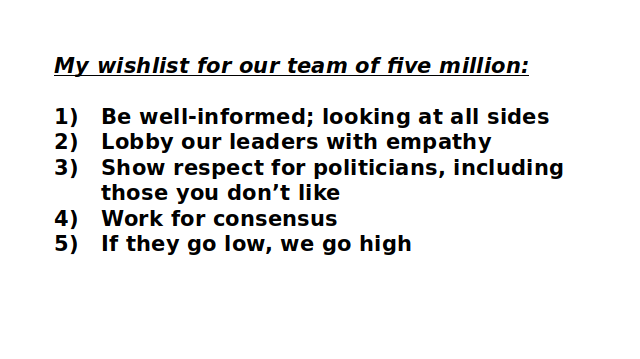
For my sermon I’d like to start off with Plato’s comment that democracy is NOT a perfect system of government, because it encourages people who are selfish and irresponsible, and politicians who have to bribe them to stay in power.
Years ago, in a very different world than this one, I had a poster in my office of a care-free panda happily munching bamboo. The caption on it read, “Who says worrying doesn’t help? Nothing I ever worried about ever happened.”
One of the challenges I have faced in both of the religious traditions I have served is when some criticise my sermons or talks or musings or whatever as too political and not spiritual enough. In my defence I try to explain my view that they are all spiritual. This generally only annoys them. It certainly doesn’t mollify them and I suffer heartburn. Perhaps if I could be less defensive it would help.
I confess I’m having a crisis of faith. Our first UU principle affirms and promotes “the inherent worth and dignity of every person”. Reverence and respect for human nature is at the core of Unitarian Universalist faith. It is a noble thought, but my problem is the overwhelming evidence to the contrary.
Considering the dust-up in Parliament over the bad behaviour of some of its ministers this week, resulting in demotions, firings, and the decision by some not to stand in the next election, it is perhaps not surprising that the story of the woman caught in adultery from the Gospel of John came to mind.
It is difficult to deny that hope is hard to find in 2020 as the increasingly out-of-control pandemic keeps knocking at our door. For nearly all of us, inside or outside our unique bubble, life has become dire or at least more challenging and fearful. But while hope is in short supply, magical thinking seems to be having a banner year. On that basis alone, they are clearly not the same.
Brenda reports that in the Food Parcel Assistance for Glen Taylor School (GTS) during lockdown, in which much of the congregation was involved, a total of $2,370 was donated by us which meant many families in their local communities were helped. The principal of GTS and Clay put together a Sunday Zoom service on 17th May which was much enjoyed.
When asked how we could best help advocate for GTS, the principal suggested we could help ensure the promised upgrade to the school property actually occurs, support an increase in wages for Teacher Aids, and continue to press for an end to child poverty and a reduction in inequality.
Racism is like the Covid 19 virus, if it can be cured it will be a challenge. Scientists are working on it, but they aren’t there yet. But they do know a few prerequisites. Racism is what Rudyard Kipling coined as “the white man’s burden” — not just for colonisers, not just for Trump supporters, not just for people who dress up in bedsheets, not just for Americans, but all white people, even for Unitarians in their predominantly white faith movement with their first three principles which are the antidote to racism. Recognising the inherent worth and dignity of every person; seeking justice, equity and compassion in human relations; and accepting one another and encouraging spiritual growth in our congregations.