We celebrate the autumn equinox with a general focus on connecting with Nature at this special time of the year. Expect a short pagan ritual, a special altar, a bit more participation than usual, and a 2-part talk. Part 1 concerns contemplation of this special midpoint between days of light and night and earth’s energies relative to our own energy. Through a story or two, Part 2 focuses on our spiritual connection with Mother Earth as our precious planet faces another tipping point.
Speaker & Worship Leader:- Barbara Thomborson
No recording this week
Read below, or download the PDF
Barbara Thomborson © 22 March 2026
Autumn equinox’26, part 1: contemplation of this special midpoint between days of light and night and earth’s energies relative to our own energy
How many of you say autumn is your favourite season? How about second favourite one? Yes, many people like or even love autumn very much. There’s so much to love about early autumn: the warm afternoons leftover from late summer but the cool nights to make sleeping easier; the long, languorous, golden sunsets; the early vegetables and fruits along with produce of late summer; leaves of changing colours that we know will start falling soon; even the moody skies and mystical mist – this seasonal change sometimes feels magical. I love the anticipation of cooler, fresher air; the change in weather that requires long sleeves and heavier fabrics, jackets and raincoats. Where I’m originally from, we say no such thing as bad weather – you just need the right clothes.
Both talks today are about different tipping points. This one asks you to consider the difference in energies between the sunnier seasons and those of more darkness.
The ritualistic aspects of today’s service come from neopagan practices. The altar is a mix of our usual flowers and earth’s seasonal vegetables, including kamokamo, a Maori squash. We sit in a circle as a community that celebrates our gathering and energy on this special day.
Here are some basics about autumn equinox: the day of actual equal day and night in Auckland occurs next Tuesday. It is the midpoint between summer solstice and winter solstice. In Auckland, next Tuesday is the day of equal day and night. I know people who rise just before sunrise on the 2 annual days of equal day and night so they can pray to the rising sun.
These next words come from “The Spirituality of Autumn: Turning Inward” © Rev. Roberta Finkelstein:-
Once upon a time, a long time ago, all religions were in some sense earth based. People across the globe lived by the rhythm of the seasons, by the waxing and waning of the moon, by the ebb and flow of the tides. They felt awe watching a beautiful sunset, fear and trembling in the face of a storm, and gratitude for the bounty of the harvest. They built their religions around those core experiences that guaranteed their survival. Over the 300,000-some years homo sapiens called earth their habitat, and very gradually, we changed our habitat to provide for our basic needs. Humanity evolved from nomadic hunter/gatherers and herders to landed farmers before our historically recent industrial and then to a post-industrial era. Globally, peoples changed their religions to reflect the reality of their daily lives. In the transition from worshipping the land to prioritising materialist industry, we lost some of the deep and instinctual wisdom and spirituality that was embedded in those ancient earth-based religions.
Earth-centered spirituality reminds us above all of what the rhythms of nature can teach us. At the time of the autumn equinox, for example, the number of hours of light and darkness are equal; it is a time of balance between light and dark that calls us to seek balance in our lives as well.
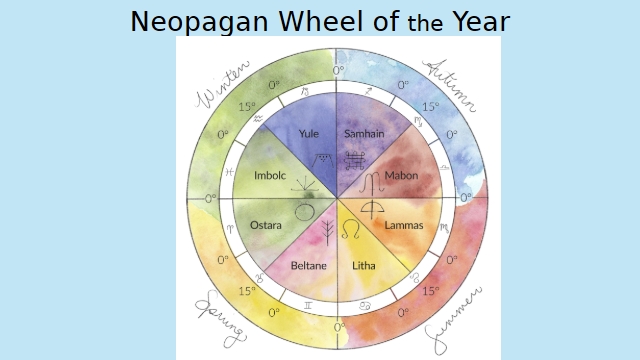
The wreath on the altar symbolises the wheel of the year. In the slide, going widdershins direction, autumn equinox is the penultimate wedge in this 8-slice circle, near the top.
In agrarian societies, autumn is a time to gather in the harvest and to take careful stock of what will be needed for the winter. In our more urban practice of this form of spirituality, autumn is a time to focus on the inner harvest as well. A celebration of the equinox might include a time of solitude, of reflection on questions like: “What have I done well lately? What have I coped with? What am I grateful for? What is the fruit of my living, the harvest of my soul?”
In terms of the rhythms of the seasons, autumn comes between the summer season of high energy activities (vacations, hiking, biking, swimming, camping, outdoor sports) and the winter season of low activity, of hibernation. As the chronological midpoint between the two, autumn is a time to slow down gradually, to recalibrate, and to balance. The balance of light and dark at the autumn equinox models for us the balance we need to seek in our lives. A balance that to some extent needs to be sought in solitude.”
So end Rev. Finkelstein’s words about Unit Univ earth-based spiritual practices and their importance to us.
So here we are on the tipping point from spring and summer to autumn and winter. We live in the duality of these days: there’s the obvious balance between day and night; between the doing energy of summer and the being energy of autumn; between the outgoing productivity and inner contemplation. We’ve been busy going out and about on holiday travels, trips to the beach and to visit friends or family; big household projects like painting walls or outdoor repairs; enhancing or expanding the garden or yard. Now it is time to transition, to come home, to ground and return to ourselves after the high energy of summer. Welcome these cusp days.
The Equinox is an invitation to turn within. It’s time to reflect on what our inner selves need to feel balanced and aligned. The end of a season can create a sense of imbalance; however, with the Equinox, we are poised on a point of balance. It behoves us to appreciate the special aspects of these three days.
Physically we want to be home more, especially if the weather ever cools off. This is a great time of year to clean our emotional and physical house, harvest our good habits, and prune or shed anything we don’t want to take with us into the coming months. Mentally & emotionally, we are gradually drawing more deeply inward. Think of it as having limited room in your mind-body space and in your physical home. What do you want to carry with you, and what do you want to put down, we you transition inwards? This is the time of year to ground, stabilize, and make space; it’s time to clear clutter in your house and in yourself.
WE will watch plants surrender their vegetation in response to shorter days and cooler temperatures. Their leaves will change colour in response to less sunlight and eventually return to the earth. We can interpret these environmental cues as a reflection of our own internal seasons; we can follow the Earth’s natural wisdom by also letting go, slowing down and taking time for fallow time. Good advice is to get more rest and develop an autumn rhythm. Equinox energy is about harmony with the earth. Come home to Mother Earth.
Part 2: Through a story or two, Part 2 focuses on our spiritual connection with Mother Earth as our precious planet faces another tipping point.
Am I alone in thinking March has been unusually warm? 9 days ago, on Friday the 13th, the low at night was 20; high in the day was 27. That night, I almost pulled out the fan for my bedroom again. Even Auckland Council acknowledges we live in long-term rising temperatures in the earth and resulting shifts in weather patterns – in other words, climate change. I’m sure each of us is doing what we can to address the climate crisis. It seems obvious to me that as the most powerful animal on the planet, we humans can and need to do more, however. Our current efforts are falling dangerously short. I especially dislike the wrong-minded solution of educating future generations to learn new ways to address the climate crisis. Part of educating youngsters about climate crisis makes sense to me, the part about how they’re better able to learn new ways. I have two problems with that: first, we are fobbing off our responsibilities for making this mess onto the victims of that irresponsibility. The second is with those ways of addressing the challenges – from what I hear, most of those ways are mainly materialistic and technological. I believe we cannot act constructively on climate crisis until society’s dominant value system stresses spiritual beliefs and personal connections with nature, specifically Mother Earth.
These are the words of Rev. Roberta Finkelstein who says so eloquently why we should develop earth-based spirituality, if not religion, to save the planet: from “The Spirituality of Autumn: Turning Inward” © Rev. Roberta Finkelstein:- (paraphrased)
In (the transition from worshipping the land to prioritising materialist industry, we lost some of the deep and instinctual wisdom and spirituality from ancient earth-based religions. That is,) until recently, when earth-based spiritual practices began to emerge again. Not surprisingly, their practitioners found a sympathetic home in Unitarianism. The increasing influence of earth-based spirituality in our movement prompted Unitarian Universalists to add another source of our spirituality, the “Spiritual teachings of Earth-centered traditions which celebrate the sacred circle of life and instruct us to live in harmony with the rhythms of nature.”
(This born-again paganism is not a return to the traditional land-based, farming spirituality; instead, it asks us to carefully consider our relationship with and to the earth. Our Unitarian Universalist take on paganism is) in light of what science and technology have taught us about creation. Evoking the tenets of environmental stewardship, this new spirituality is concerned with ending the exploitation of the earth, inviting a new reverence for the natural world and replacing the image of humanity as the crown of creation – free to manipulate the environment for our own needs – with the powerful metaphor of the interdependent web. Our new earth-based spirituality affirms the intrinsic value (some would say the divinity) of all living things – trees and mountains and animals and people. Out of reverence for this divinity which is so immediate (or immanent as theologians are fond of saying) in our surroundings, we attempt to live carefully and mindfully on the earth.
Consider this partial list of historical, indigenous and pre-colonial names for Mother Earth:
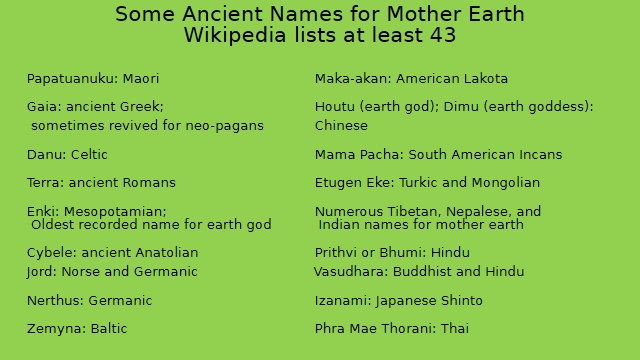
I have chosen only the names that to me mean a deity that lives and breathes and has eternal powers that come from her body. I use ‘her’ because the vast majority of names for our idea of Mother Earth come from goddesses.
As much as I would love modern Nzers to revert to paganism to save the planet, I stress that however we do it, we need a strong religious connection to our earth and nature. Some of you may remember from my talk on developing spirituality that strong spirituality requires you to get out or your ‘mental mind’ and slip into a more emotional, intuitive mind. This spiritual mind enables you to find powerful meanings in stories, fairy tales, stories, and myths. I find the word ‘myth’ patronising and even dismissive of the verbal ways people in other cultures have expressed their spiritual beliefs. A Tokelauan elder described this well: when he first encountered Christian missionaries, they called Tokelau’s ways of communicating the nature-oriented spiritual beliefs of their gods as ‘myths’, whereas when the missionaries spoke of Christian biblical ways of doing the same thing, they were telling ‘stories’. So I do not use the word myth anymore.
So, before listening to this story, let’s imagine ourselves as ancients who have gathered to hear their priest or priestess tell an important story from their religion.
Imagine yourself as an ancient person, maybe Greek or Celtic or Tokelauan. Close your eyes if that helps you imagine yourself as this person. You live in a world where everyone believes, fervently, in the super powers of your deities. You believe, beyond doubt, that humanized gods and goddesses can make or break the fortunes of your life and everyone you love; they can make or break whole empires and control the forces of nature. Your gods transmit the greater mysteries of life and also control all things you cannot understand – they control all mysteries and are mysteries themselves. You believe, with every cell of your body, that these gods and goddesses have the power to create and destroy life by controlling the forces of nature. The power of your gods permeates nature, and Nature manifests the power of your gods. You feel fear, gratitude, and awe in your daily encounters with these gods and goddesses.
In this spirit, listen to the story of Kapaemahu, leader of four loving people with special healing powers. Long ago, so long ago it was even before that noble Chief Kakuhihewa, these four Tahitians crossed the oceans to help the people of Oahu in Hawaii. The visitors were tall, with deep, rich voices, yet they were gentle and soft spoken. They were mahu – beings who were both female and male in their minds, hearts, and spirits. The Gods had blessed these four mahu with special skills in healing people. All mahu had spiritual power, but of these mahu, the one with great spiritual power was Kapuni; Kapuni could channel healing energy from the air without using their hands. The mahu Kinohi was all-seeing; Kinohi could look into people’s bodies and see illness and health. The third mahu, Kanaloa, could heal from afar; Kanaloa’s power was to express this healing from a distance. Lastly, Kapaemahu healed by touching people with their hands.
When these healers had finished their healing and teaching the Oahuans better ways to heal, the people wanted to express their gratitude for the wonderous cures. One moonless night, the people gathered at Kaimuki, a place that had a famous bell boulder. Sweating and straining all their muscles, the whole village moved four great boulders all the way to Waikiki. AS the sun rose after the moonless night, the four healers began to transfer their powers into the stones; such was their powr that they could put idols that represented the dual spirit of mahu under each stone. The ceremonies and celebrations lasted a full moon. Then, knowing that their healing powers were safe in the stones, the mahu vanished.
The people worshipped those sacred stones and the ground under them for centuries. Many people who worship or meditate on the stones can still sense the spirits of those mahu today. The mahu energy lives on in those stones.
(Keola Whittaker also talked about this story in his 8th February 2026 talk “The Stones That Testify”)
Meditation / Discussion Questions
- How do you anticipate the days of dwindling light and passing of outgoing energy? Do you do anything special to prepare for them? Do you do look forward to turning inward?
- How do you describe your spiritual connection with ‘Mother Earth’? Is it strong enough to enable you to ‘walk lightly’ on Her and motivate you to do all you can to improve her health?
- What do you think of the link between myths and spirituality? Did today’s service change, even a tiny bit, your thoughts on that?