20 November is International Day of Remembrance of all those in the transgender community murdered in hate crimes in the previous 12 months. The transgender community have become the target of disinformation and vilification by politicians and the far-right. Perhaps it is time for the rest of us to stand up to transphobia.
Speaker & Worship Leader:- Maria Hayward
Read below, or download the PDF
Follow this shortcut to the bottom of the page for the various readings, videos, etc. shared in the service.
Maria Hayward © 16 November 2025
A couple of years ago, on Nov 20th, my daughter asked me if I wanted to go with her to a special service at St Matthew-in-the-city for “Transgender Day of Remembrance”. We sat nervously, in the candlelit church, and read, in somewhat shock and distress really, as hundreds of names scrolled in a datashow list in front of us. These were the names of 370 transgender persons – almost all women – who had been murdered in the previous 12 months because of their gender identity.
And they were only the names of people from countries willing to report these hate killings, and only of those who were identified as trans at their murder.
I imagine there were many, many hundreds more – not counted.
As mentioned earlier, Transgender Day of Remembrance (TDoR) was initiated in 1999 to commemorate transgender people lost to violence in the preceding year. The day is also an opportunity for raising visibility of the transgender community and for considering the issues they face.
Typically, this memorial would include a reading of names, but today we won’t be doing this. Instead, I’ll be quoting some statistics to inform you of the extent of the extreme vulnerability of this group. A group that deserves our attention and our empathy.
Perhaps then, on this journey of empathy, we need to start with an understanding of what transgenderism means.
What does science tell us? Basically, science confirms what transgender people themselves have told us: that children are born trans – just like children are born gay or bisexual or white or black or with red hair or with 6 toes or whatever. Importantly, it is known that the brain develops in the foetus a couple of weeks before the exterior gender identifiers, and endocrinologists suggest that, between these 2 developmental stages, the hormones in a mother’s uterus alter and the child’s physical gender develops differently from their brain gender.
Transgender and other rainbow individuals exist in every society and always have. There are examples of gender diversity in the literature of many ancient civilizations. Additionally, mostlanguages have or had terms for a range of genders and sexualities. Many languages have lots more words than English has for gender and sexual identity. In at least one North America first nation language, there are 5 words for (5) different genders. And lots of other indigenous languages have 3 or 4.
But there is a new intolerance for transgenderism,and the new hate rhetoric has consequences. Let’s look at what’s happening in Aotearoa. I’m going to quote some statistics, which I hope are not too confronting.
In Aotearoa/NZ, Godzone (apparently):
- 1 in 5 trans people have been threatened with violence
- 1 in 10 have experienced deliberate violence
- 50% have self-harmed
- 53% have considered suicide
- Up to 42% have attempted suicide (this figure varies from year to year)
- And there has been a four-fold increase in transphobic hatecrimes over the last five years (particularly following trans-bashing from politicians and anti-trans public speakers).
- In fact, in the year after Posie Parker visited NZ, the number of reported crimes against the rainbow community doubled.
These worsening statistics are pretty much mirrored internationally. Data collected across 30European countries, found that transgender people experienced more discrimination and violence than any other gender group. And it’s getting worse.
In the US: Murder of trans people has nearly doubled in the last five years and hate crimes have increased significantly. About 95% of trans-murder victims are female, and a high proportion are black. I imagine this is due to a combination of racism and also misogyny. Some men can’t believe anyone would transition from male to female – after all – why join the inferior sex, the disadvantaged gender? Femme gay men also say they are much more frequently abused than straight-appearing gay men. Toxic masculinity has a lot to answer for. But so do politicians and others who feed this dangerous insecurity.
Within hours of the Kirk murder in the States, the far-right escalated their campaign against the transgender community. This came with the full backing of the Trump administration. Shockingly, there were calls for:
- Nüremberg type trials for doctors who prescribe hormone therapy for transgender patients.
- and a call for all transgender people be institutionalised
- for trans activist groups in the US to be named ‘domestic terror groups’
- and it was proposed that: trans people be (quote) “taken off the streets” (I really hate to think what that might mean…)
So, the question remains: what can we do to stem this tide of hatred and violence towards the transgender community? And how can we Unitarians turn our kaupapa of diversity and inclusion, into action.
Trans people are amongst us – in our church, in our workplaces, in our families, and in our toilets (yay!). They are not hurting us – but we are we hurting them.
All trans people deserve rights (all human beings do) – and everyone deserves respect.
Another question you may be interested in: how many trans people are there? The latest NZ census showed 0.5%. That’s 1 in every 200 persons, or at least 5 kids in every secondary school in NZ. I bet that’s more than you thought. In the Netherlands, Norway and Brazil, the number is a lot higher – about 1.5%. Statisticians think this might be the more accurate, true percentage, but trans people are often closeted and don’t put their hand up to be counted (till thy feel accepted by society). So this number would represent, for NZ, about 15 trans kids in every secondary school in Aotearoa.
As you know, Universalist Unitarianism says that“beliefs and values are empty unless they are expressed in action”. So, what can we do? For a start we can begin rebutting theliesof anti-trans activists (the Posie Parkers, Joanna Rowlings, the politicians, and others). Ok, so, what are the lies and myths we are currently hearing? The myths we can begin rebutting? The rebutting, the standingup against transphobia, is action we can take – in our friendship groups, in our workplaces, on the bus or train, even or maybe especially, in our families.
I’m going to look at the 4 key anti-trans myths now. A couple of these affect transwomen only. It should be noted, however, that trans young men will shortly be very negatively affected by Simeon Brown’s announcement that puberty blockers will be ‘paused’ for them. Both transwomen and transmen suffer bigotry in a range of forms.
Myth 1: Female toilets are unsafe when shared with transwomen – here we need to look at the science. There is not one piece of evidence that a single cis-gender (non-trans) woman has ever, anywhere in the world, been attacked by a trans woman in a public toilet. Trans women are sharing our toilets right now – the reason you’ve never noticed is because they walk in and out just like the rest of us do – and they’ve never hurt us. But – are transgender people safe in toilets? Probably not. What about non-binary or non-gender-conforming individuals – where can they safely go to the toilet?
And as you will know, the biggest danger to women today, is actually men in their own homes!
Let’s focus on really making toilets safe for everyone and that means especially now for trans people.
Myth 2: Education programmes that teach about different sexualities and gender identification somehow encourage or brainwash young people to become trans, non-binary or even gay etc. Some members of our current government are voicing this notion and it’s one of the reasons the NZ Ministry of Education has been directed to remove guidelinesthat were in the previous Relationships and Sexuality Education (RSE) programmes which encouraged schools to, amongst other things, “normalise transgender identities”, and to use inclusive language and practices (e.g., preferred pronouns and names). Under a coalition commitment between the National and NZ First parties, the Ministry was directed to remove these specific guidelines, and this occurred in February, 2025.
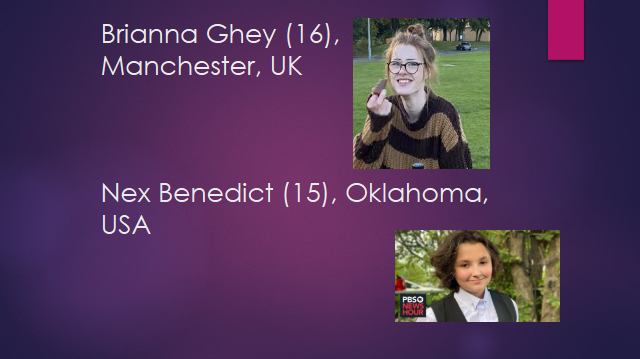
Let me briefly tell you the tragic stories of some young transgender schoolgirls. Two years ago 16-year-old Brianna Ghey was murdered in Manchester. Her killers were 15 years old, and had been radicalised in the dark web. I suggest this is where we should be focussing our education programmes and our media attention, not on innocent transgender kids! Earlier this year, an 18-year-old transgender English girl was stabbed multiple times, but luckily she survived. And last year, Nex Benedict, a 16 year-old non-binary school student in the US was beaten in their school toilets. They died a few days later. It is said she died of suicide. She had been bullied and harassed for 2 years at school before the toilet beating, during which she suffered severe head trauma. These were just teenagers, hurt and killed by other teenagers.
Myth 3: (sort of connected to the myth that young people learn to be trans)and this myth is thatpeople choose to be trans. But I have to ask, who would choose prejudice, bigotry, hate, ridicule and personal danger. Seriously, nobody wakes up and goes: “Wow, maybe my life would be better if I transitioned to be a woman, alienating most of my friends and my family; being persecuted at school, making myself open to bigotry and violence – yeah I’ll choose that”. Not likely.
And finally, there’s the biggie: Myth number 4: the myth about trans women in sport: So often, ‘logic’ or so-called ‘common sense’ takes precedence over science, so often common sense is actually non-sense. I went to the trouble a couple of weeks ago, to look at the science on transwomen in sport.
Research in this area is limited, but, in general, the consensus is that hormone treatment actually decreases rather than enhances performancefor transgender women. One study did find that trans women retained a residual small advantage in running speed, but several other studies contradicted this and actually showed that feminizing gender affirming hormone therapy (GAHT) led to significant declines in speed, strength and endurance in transgender women. Furthermore, other studies have found that, relative to body mass, transgender women have lower cardiovascular fitness compared to cisgender women, which can negatively impact speed, recovery, and endurance.
I think it should be noted that tall people have an advantage in most sports – especially running and jumping competitions and they are better basketballers than not so tall people; larger built people have an advantage in rugby and other strength-based sports. Someone once told me (true story) that Dutch people shouldn’t be allowed to compete in Olympic swimming because they have big feet – natural flippers – an unfair advantage! Sport is not fair – some bodies are much more naturally inclined to be more successful than others.
Despite concerns about competitive fairness, transgender women are actually underrepresented per capita at the elite level and have not dominated women’s sports. The few who have competed at the highest levels, like Laurel Hubbard at the Olympics, have had mixed results. Maybe they weren’t tall, or maybe they had small feet!
Ok, so why are we doing this today? Why should we care? I listened a while ago to a talk delivered by Professor Spoonley in this building and the topic was ‘hate speech’. He said that the most importanttasks in fighting hate speech – apart from government policy – are listening to the affected community and being well-informed – I’m trying to help with the latter.
We, as UU’s, may consider it important, as a caring community, to think about all minority groups who are oppressed – and today is the day to think about transgender people. The 370+ who will die in the next 12 months. Deaths that would not have happened in a world where minorities are valued and included.
I think fighting for minority rights is something we all should do. Those of us lucky enough to be born into a majority, favoured group: white, middle class (probably male cis-gender) and safe, perhaps have a moral obligation to do so. What’s more, you never know if you might need to be the support person for a trans member of your own extended family. Possibly some of you already are – and I imagine you’d want to get that right. Kia ora koutou ki te arohanui me te manawanui. I wish you so much love and strength.
Closing words
Let’s celebrate transgenderism. Let’s not think of it as a negative or a deficit in any way at all – but rather as something fabulous that reminds us of our individualism – and that expands the wonderful diversity that comprises our community. Let’s be admirers of the brave individuals who survive transitions and public opinion. It’s no coincidence, I think, that there are several transgender members of this community. Let’s continue to not only welcome, but also to honour everyone who is a member of a minority group, for their bravery, their beauty and their contribution to a more diverse and interesting community. Let’s also be proud that NZ had the first transgender MP – the Hon. Georgina Beyer, and ‘almost’ the second transgender mayor – Jackie Grant. Good on Westport. Good on Aotearoa small towns!
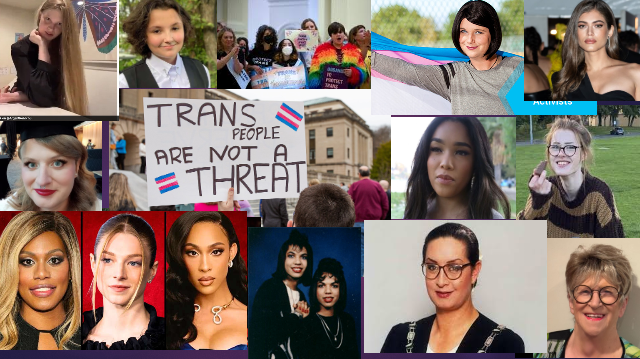
This photo collage includes some well-known transgender women – the people some groups say we should be scared of in public spaces. The photos include the two NZ politicians, Elon Musk’s daughter (Vivian Wilson), Savannah Ryan, the twin mentioned by Ruby in the introduction and other fantastic trans women living in our communities today.
Arohanui ki a koutou katoa.
Meditation / Conversation starter
- Are you brave enough to stand up to transphobia?
- What rebuttal do you favour if you hear mistruths?
Links
- Chalice Lighting:- “First Principle Chalice Lighting” by Florence Caplow
- Reading:- To Come
- BBC article referencing ‘four-fold increase in transphobic hatecrimes’
- UU talk on hatespeech by Paul Spoonley